
Doctor's Notes: Obsession, The Taste of Tea, and Mothra vs. Godzilla
on anti-reality, transcendental backflips, and worms beating the shit out of a giant lizard

Welcome to Doctor’s Notes, where I — Charlotte of The Treatment — share some shorter but still Treatment-coded reviews for films I’ve watched lately. This will largely comprise recent and/or more commercial films so that I can keep my foot in the Rotten Tomatoes door while also introducing the widest possible audience to the New Film Criticism.
If you’re coming here from Rotten Tomatoes, know that “Fresh” and “Rotten” ratings indicate my personal enjoyment of the film only; they are not a testament to whether or not they’re worth watching. If I write about a film, that means I consider it worth watching.
I give star ratings for every film I plan on including here over at my Letterboxd account, where these reviews will then be posted after the Doctor’s Notes post goes live. Follow me to get a sneak peek at what I plan on writing about!
Table of contents:
Obsession
Obsession
Spoilers ahead!
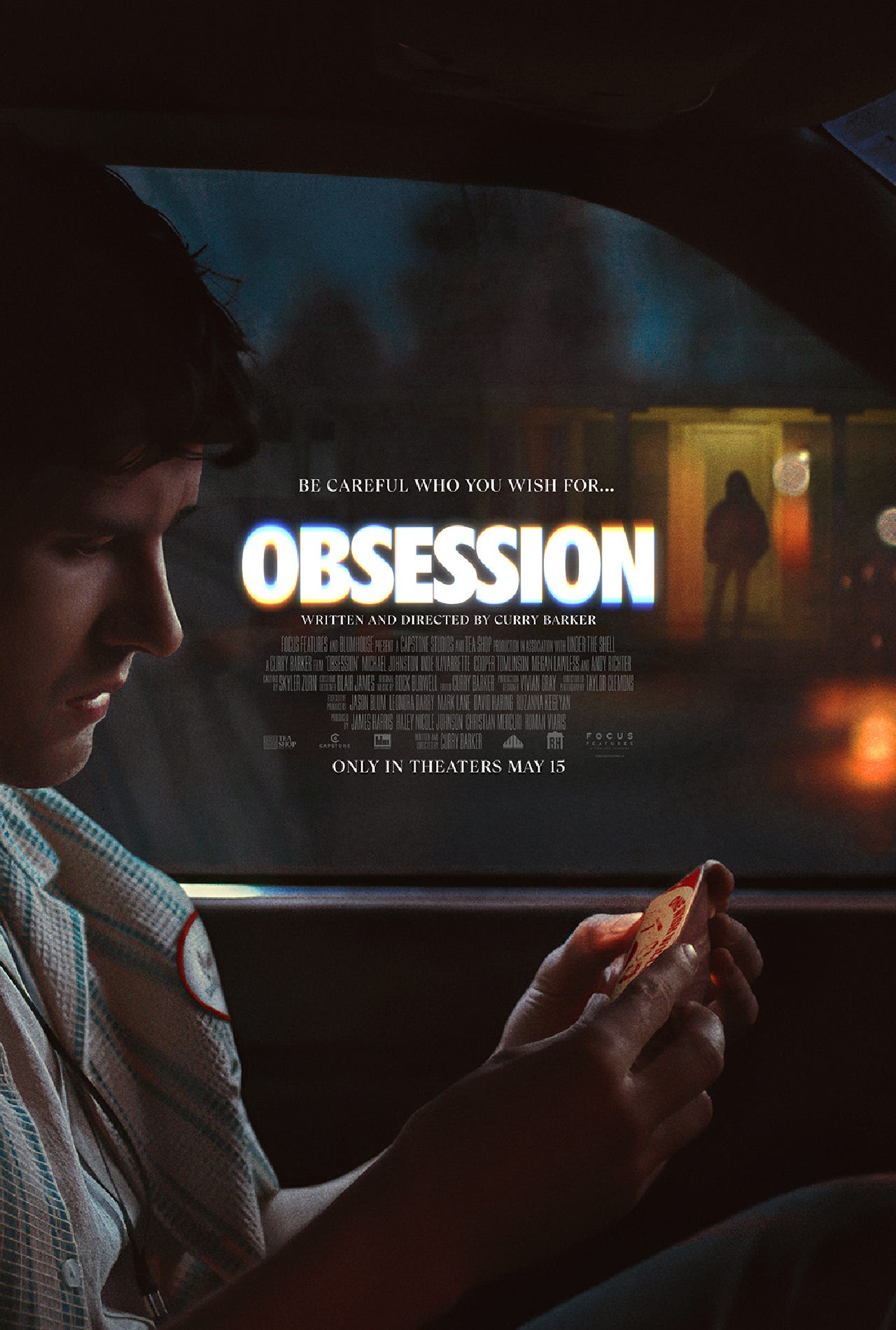
Bear does not know what real is, and he is debilitatingly common in this respect. Obsession takes place (at the earliest) in 2023, so reality is already under attack by a misinformation paradigm that’s only barely begun to clear its throat; a context nodded at by Bear’s use of AI search engines in at least one scene (I think I counted two). To make matters worse, he’s in that all-too-familiar male situation where the majority of his relationships boast little to no vocabulary in emotional sincerity. Ostensibly, the only consistently real thing about his life is pain; a medicine cabinet stuffed with oxycodone certainly gestures to that.
And Sarah, yes, but recognizing her as real requires a literacy in real that Bear does not have. Pain — a universal language — asks no such thing of those it speaks to (as a matter of fact, it doesn’t ask anything at all; it imposes without consent, a most insidious teacher for Bear).
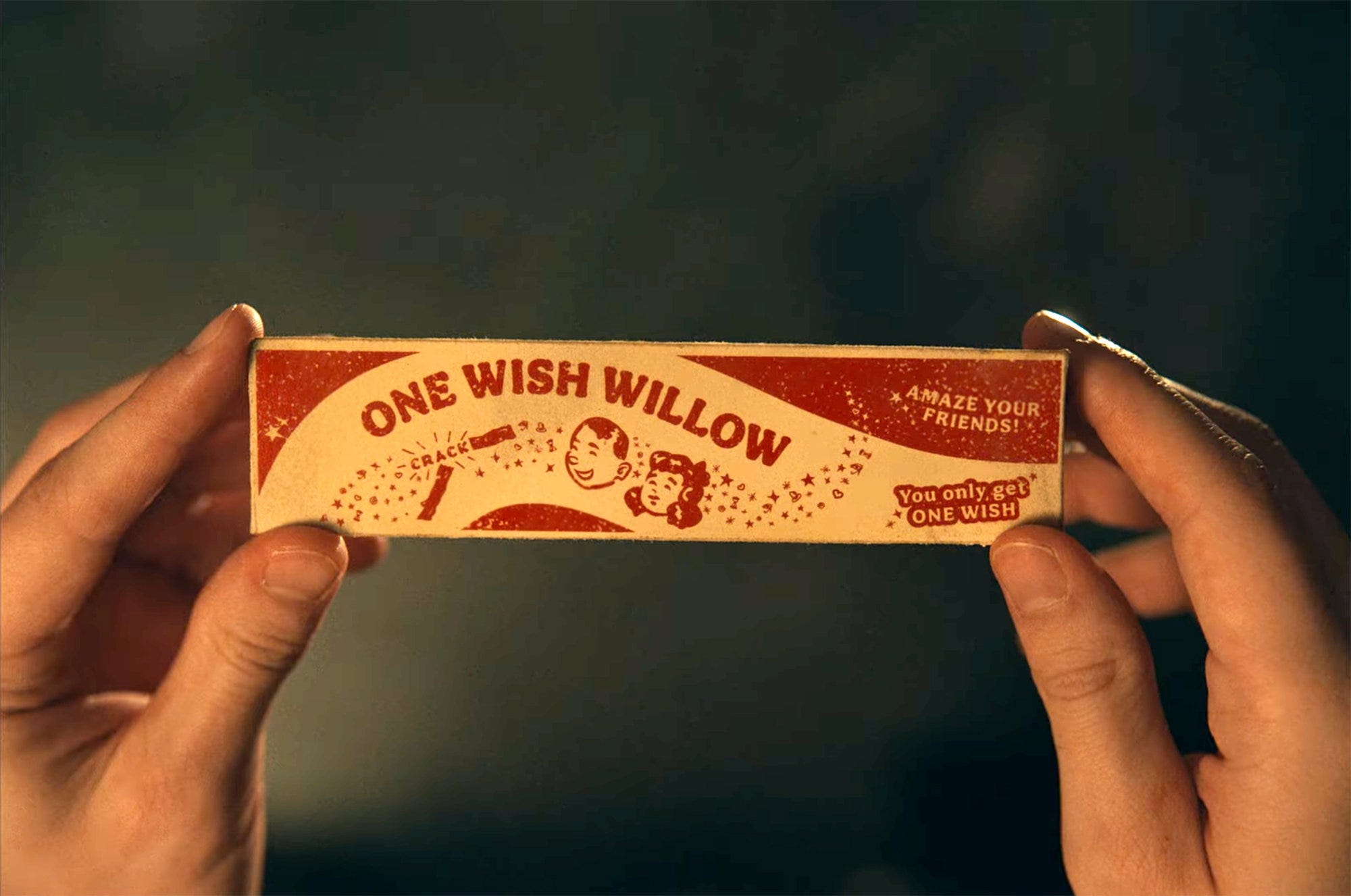
Put another way, Bear is either A.) Unable to recognize what real looks like and so gravitates towards fantasy the way I gravitate towards English signs whenever I’m in Montréal, or B.) He is so utterly terrified of, jaded by, and pessimistic about reality’s blend of harsh-and-flaky that he knowingly and deliberately commits to fantasy. Coupled with the offense he takes when Nikki begs him to kill “Nikki” (“What’s so bad about being with me?”) and his inability to own up to his cosmic-grade selfishness by killing himself and freeing Nikki (he chickens out of shooting himself, swallows the oxycodone instead, but then tries to throw up), it’s no great leap to read Bear as possessed by the whim of a willow branch in his own right. Ditto all those real-life boys and men1 — many of whom are responsible for the aforementioned tech-heavy storm of unreality that Bear and his peers are coming of age in — who make to purge the personal sovereignty of others if it means they never have to confront their own fears and insecurities around being in the world. In this way, the fantasy of Bear x Nikki has the same underpinning principles of the fantasy of, say, white supremacy.
It tracks, then, that Bear is apprehensive about telling Nikki how he feels. Making his feelings known for her would mark the starting point (and, as we later find out from Ian, probably the end point) of a reality-based Bear x Nikki, thereby pulverizing the fantasy, which is what Bear is actually attracted to/dependent on to cope with reality. The fact that Nikki — the personification of his attraction — is a fiction writer compounds this note even further.
And just as well, Bear x Nikki never really stops being a fantasy — complete with the maintenance it requires to keep reality out — even after Bear breaks the One Wish Willow. Prior to the wish, said maintenance took the form of Bear’s bashful posturing when he’s around Nikki and panic-denial when she probes his feelings. After the wish, it takes the form of Bear’s Olympic-grade eggshell walking and star-crossed reassurances to keep the black hole of “Nikki” — and, by extension, himself — secure.
The emotional subtext of Bear’s fantasy is one of scarcity; something he does not have, the fixation on which leads to anxiety, bitterness, and even desperation.
And if the surface of any fantasy (i.e. Bear x Nikki) comes true, it tracks that the subtext survives with it. Sure enough, anxiety, bitterness, and desperation are all apt descriptors for Bear and Nikki’s “relationship,” to say the least
It’s not terribly different from the fantasy enabled by Ian with his placating “Just wait for the right time”’s and avoidant calls for jello shots when the party gets uncomfortable, to say nothing of the secrets he’s hiding from Bear re: his hookups with Nikki in spite of Bear’s feelings for her.
But that doesn’t even approach the most tragic reminder of Ian representing Bear’s poisoned relationship with reality. Indeed, when Bear finally shows up at Ian’s house — covered in blood and snot and other fluids native to the first fact of reality (i.e. the human body) — and begs him, screams at him to listen when Bear says “It’s real!! It’s real!!,” Ian flippantly wishes for a billion dollars instead.
Bear falls to his knees; he made one last desperate plea to reality — to a fabric of shared trust that’s been strategically frayed across the country — and was promptly punched in the face by a spectre that uses unreality to build its first ranks with men like Bear, who are desperate enough to serve as footsoldiers of selfish domination so long as it looks like dreamy synth scores and cutesy montages and whatever else serves their twisted equivalent of happiness.
And so he dies. And then he commits suicide.
Few other notes/stray thoughts:
I would make just one change2:
First, recall the very last scene: “Nikki” is crying, holding Bear’s corpse as a pseudo-tragic score plays, shifting to a horror-tension ramp-up as she reaches for the gun and makes to shoot herself, said music cutting when the One Wish Willow spell wears off before she can pull the trigger.
Now, throughout, Obsession trains the audience to read music as a red herring (see: the aforementioned dreamy synthwave score contrasting with the sheer horror of this relationship). Meanwhile, Hollywood fare has — knowingly or otherwise (I’m Team Otherwise; I wish I wasn’t) — trained audiences for years on “tense” moments telegraphed by “suspenseful” string suites, despite 99% of these moments having an obvious outcome that works in favour of the person we’re cheering for.
Put together, the brief string suite that plays as “Nikki” puts the gun in her mouth basically telegraphs that she’s not going to shoot herself.
If you ask me, both outcomes — “Nikki” shooting herself, and the spell wearing off before she can — are conducive to the text of the story in different ways, and coupled with the bad-to-worse momentum of the narrative, the question of whether Nikki will shoot herself can absolutely work as a genuine “What’s going to happen?” moment that so many Hollywood films often fail to create.3
With all that said, here’s my two cents: What if, instead of the music swelling from weepy to forboding, it fades out completely, leaving nothing but stagnant air as “Nikki” reaches for the gun? Food for thought.
“Do you want to talk to her” ranks among the most terrifying scenes in any horror movie I’ve seen in the last several years.
Moreover — and this relates to the previous bullet point, too — it’s unbelievably refreshing how well Barker understands the difference between horror and tension. The above scene is horror, while Nikki standing behind Sarah’s chair at the party before pulling it away from Bear is tension.
Not to say, of course, that these things result in empirical sensations of horror and tension; different bodies experience/hold these things in different ways, and so actual effectiveness varies from viewer to viewer. What’s undeniable, though, is the geometric literacy with which horror and tension are expressed; not once — to my memory — does Barker try to pass a jolt of the nervous system off as either one of those things.
Adding my missing this at TIFF to my very short list of regrets. Seeing this with a proper crowd would have been everything.4
Curry just gets it, and more importantly, he gets himself. Can’t wait for Anything but Ghosts.
The Taste of Tea
…isn’t really the point of tea, is it? It’s more about the intangible/unseen elements of drinking tea; health, warmth, its function as a social nucleus (sociality of course boasting its own dimensions of health and warmth). I suppose if you’re as young as Sachiko, though, you’re liable to misunderstand these benefits as stemming from the tea’s taste.
She’s the daughter of the Haruno family, also comprising son Hajime, mother Yoshiko, father Nobuo, grandfather Akira Todoroki, and visiting uncle Ayano, all of them at different stages of embracing their inner — intangible, unseen — worlds.
Akira, the verbosely eccentric enigma of few words. He goofs around with his grandchildren and exaggerates poses to help his daughter with her animation work, modeling the capabilities of imagination even before they’re captured on the drawing page. He is the human element unleashed, the mutual osmosis of the inner and outer worlds into some uncharted outcome that’s completely Akira. He has nothing left to learn and one more lesson to teach.
Yoshiko, a mother in the unique position of balancing motherhood with her dream of becoming an anime artist; sketching, colouring characters direct from the inner world of an artist’s imagination, striving for a station that will allow this inner world to tangibly sustain her outer one. The applause from her coworkers after watching some of her work signals a key narrative win-state in that sense.
Nobuo, who we don’t get quite as much access to compared to the other characters, and indeed almost exclusively engage with him through other members of the family. And when we do, he expresses the stoic-adjacent discipline of anyone you’d come across in public; someone whose inner world most won’t admit they probably wouldn’t think twice about.
He also works as a hypnotherapist, thereby supporting himself and his family by primarily concerning himself with the inner worlds of others, which — on the surface, and considering how little we see/he shows — conflicts with how much attention he can dedicate to his own inner world. Sad at first, perhaps, until he gets a call in the middle of work from Yoshiko about her success at her showcase, after which he tells his patient “my angel is a telephone.” Sometimes, the truest version of oneself doesn’t look like Akira, or much of anything at all, and it’s no less remarkable.
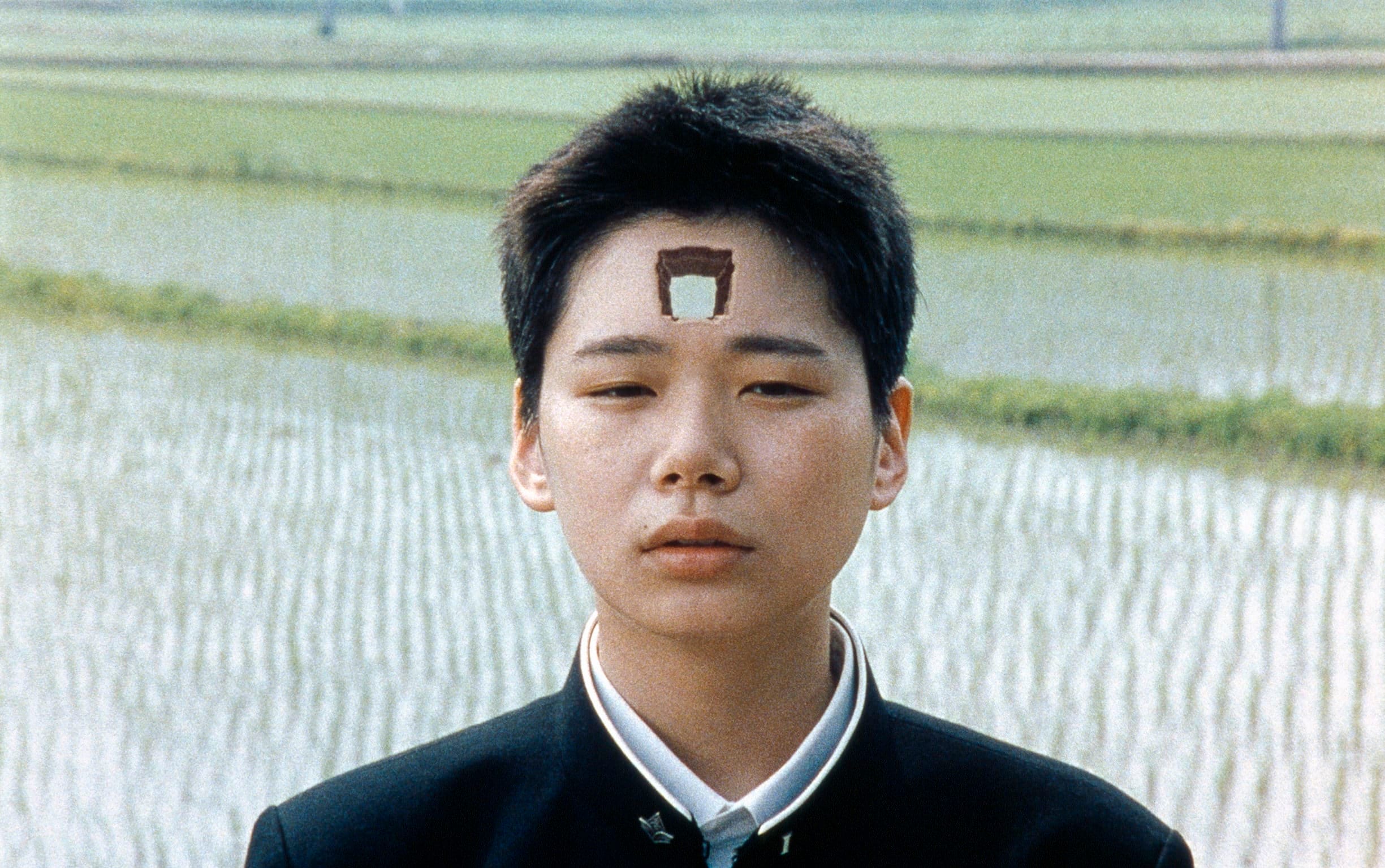
Hajime, taking his first steps into the realm of teenagedom and immediately distraught when his crush — who he has never spoken to before — moves away. He is cured the next day with the arrival of transfer student Aoi Suzuishi, who he fantasizes about protecting from a hypothetical unseemly aggressor, complete with subtitles for combat quips that we can’t hear because those words occur entirely inside the head (inner world) of Hajime.
He is also afraid of women; a trait our narrator contributes to The Soba Shop Incident — in which he found himself sitting across from a couple having a sleazy, misogynistic back-and-forth about the woman’s upcoming breast enlargement surgery — and The Convenience Store Incident, in which he overhears a patron tell the cashier about how his girlfriend beat him up, after which said patron passes by Hajime and he sees the deeply bloodied and moderately rearranged remains of their face. Both of these incidents, rooted in the first fact of the outer world that is the human body; biological and material.
But that’s not what Hajime’s love is for, and indeed — surrounded and sometimes pranked by classmates who only talk about girls in a sexual, bodily sense — his odyssey is one of learning to let his wholesome inner love flourish. The progress in that journey, meanwhile, is all packed into a climax of a different breed than the ones that other teenage boys might be chasing.
First he — alone with Aoi as the only two present members of the school’s Go club one day — tells her that it was his dream to play Go with her, to which she smiles and says “Let’s play every day, then,” before letting him walk her to the bus stop in the rain.
And then, just as the bus door closes, he tosses the umbrella into the bus so that she’ll be safe from the rain for the rest of her walk, waving as the bus leaves before running home in an ear-to-ear ecstasy, because he — in all his pure altruism — did good by the love in his heart.5
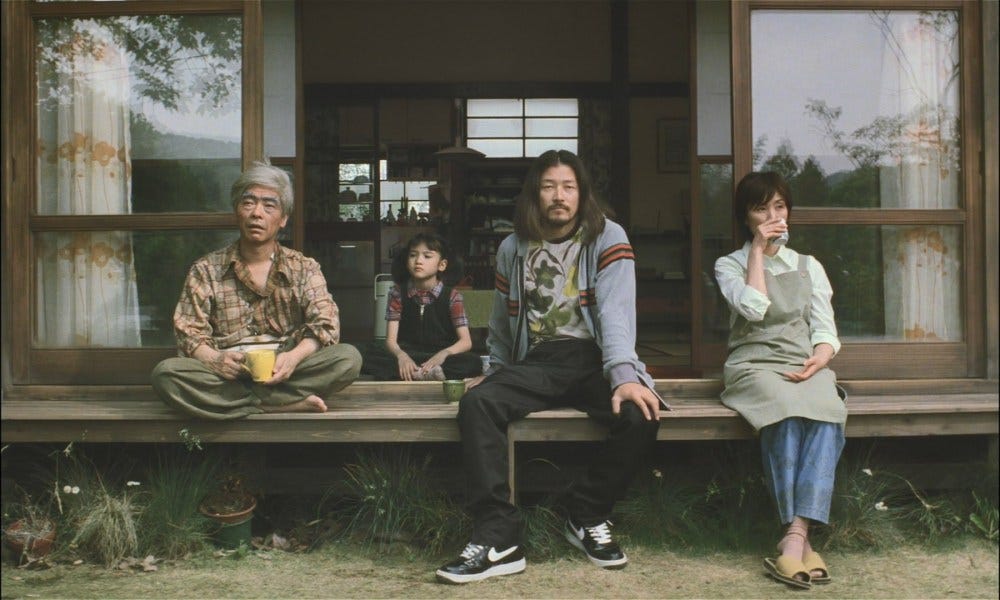
Now, the development of one’s inner world doesn’t always correspond with age, and sure enough, Ayano seems to still be figuring things out. Like his brother Nobuo, he makes a living from attending to the inner worlds of others, albeit as a sound mixer, so not quite the same level of intimacy. More explicitly, his awkward reunion with his old love Terako — whose husband is an artist for similar parabolic reasons that Yoshiko is one — is tinted with pain and regret, perhaps, but it also expresses a shared unfamiliarity with talking about emotions in a way that’s real. It’s no wonder they didn’t work out.
Except, where is it written that intimacy must be how we measure the remarkability of the inner lives we lead? Is Ayano’s ability to candidly form playful understandings/friendships with far-off baseball hitters and river dancers named Morio — the latter of whom he jives with enough to invite to dinner that same evening — not its own form of richness?
Pedestal intimacy to your heart’s content, of course, but don’t come crying to Ayano when you find that the depth of connection with oneself only goes so far without the breadth of curiosity that allows us to engage with and impact each other, however briefly. And indeed, Ayano is, remember, only here for a visit.
And in that time, there is perhaps no one that Ayano will impact quite as much as Sachiko, still in elementary school, always frowning, tormented by a giant version of her older self that she’s desperate to get rid of; the ghost of all that she is not yet, all of that which she does not know, all of that which she must come to know. Of course she frowns; that’s intimidating shit, man!
She overhears Ayano recounting to Hajime about how a shirtless yakuza member — a ghost-type like Sachiko’s giant future self — used to appear to him as a young boy after he unwittingly took a shit in the woods on top of where said yakuza member was buried, only vanishing after Ayano successfully did his first backflip on a horizontal playground bar.
We audience members learn that the yakuza ghost’s disappearance had absolutely nothing to do with Ayano’s coincidental backflip, but it’s in that moment that Sachiko begins to canonize a backflip — which she has never done before — as the next step in her journey of conquering life’s possibilities, which is as legitimate a next step in that journey as anything.
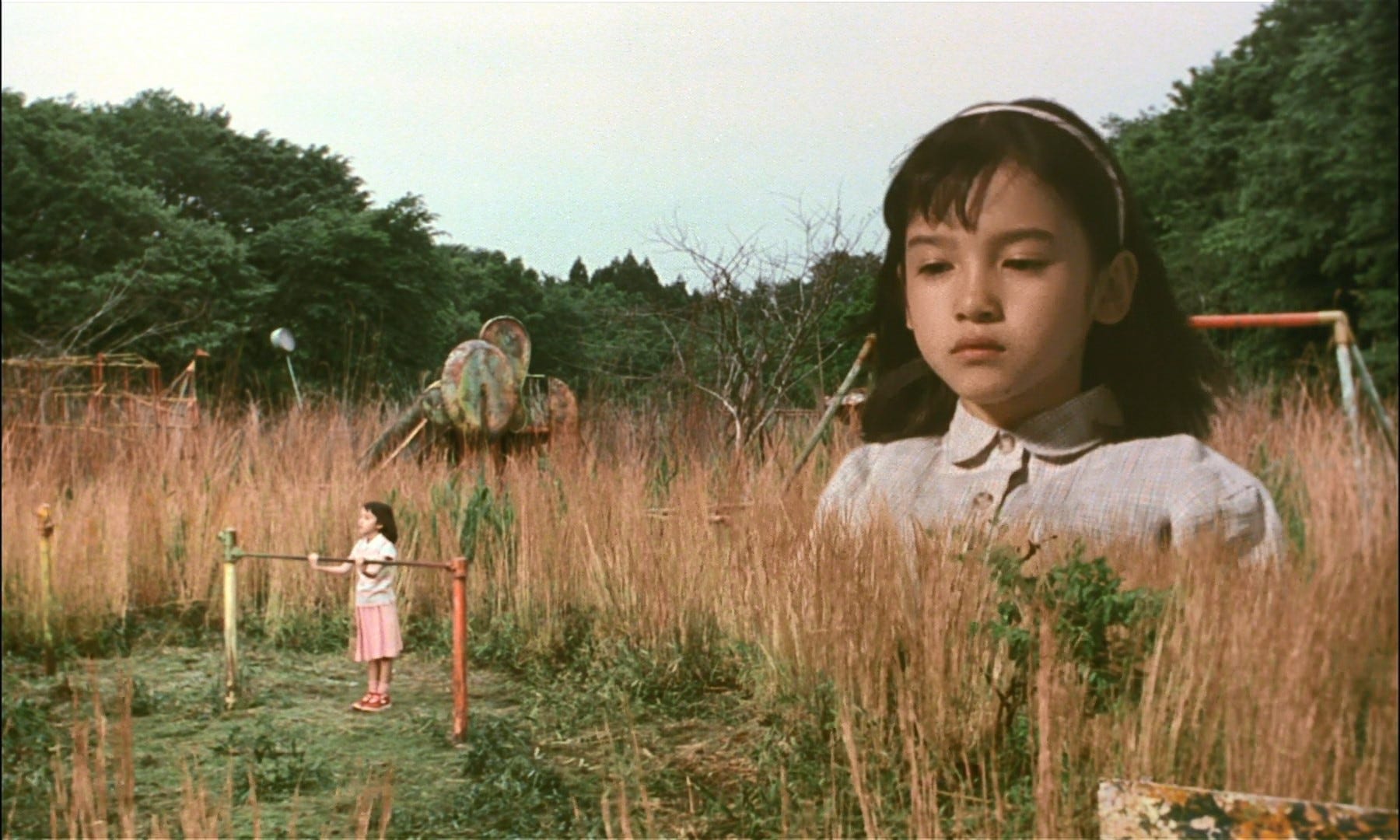
By the end of the film, she finally pulls it off, after which her giant future self vanishes before the Earth, Moon, and Milky Way are gradually consumed by an ever-expanding sunflower; enlightenment stretching forward into infinity, spanning the extent of all that Sachiko — and all of us humans — may or may not existentially reckon with in our lives.
And then we snap back to Earth, where Sachiko does another backflip, and unceremoniously walks away with an enormous smile on her face. The backflip has become charted territory, so what’s stopping her from understanding the far reaches of the galaxy? Yeah, that’s the smile of a human element that finally understands how unstoppable it is.
—
Quite safely the richest first-time watch of the year for me so far, even if it’s not quite my vibe. Definitely drink in the 4K theatrical re-release if you have the chance:
Mothra vs. Godzilla
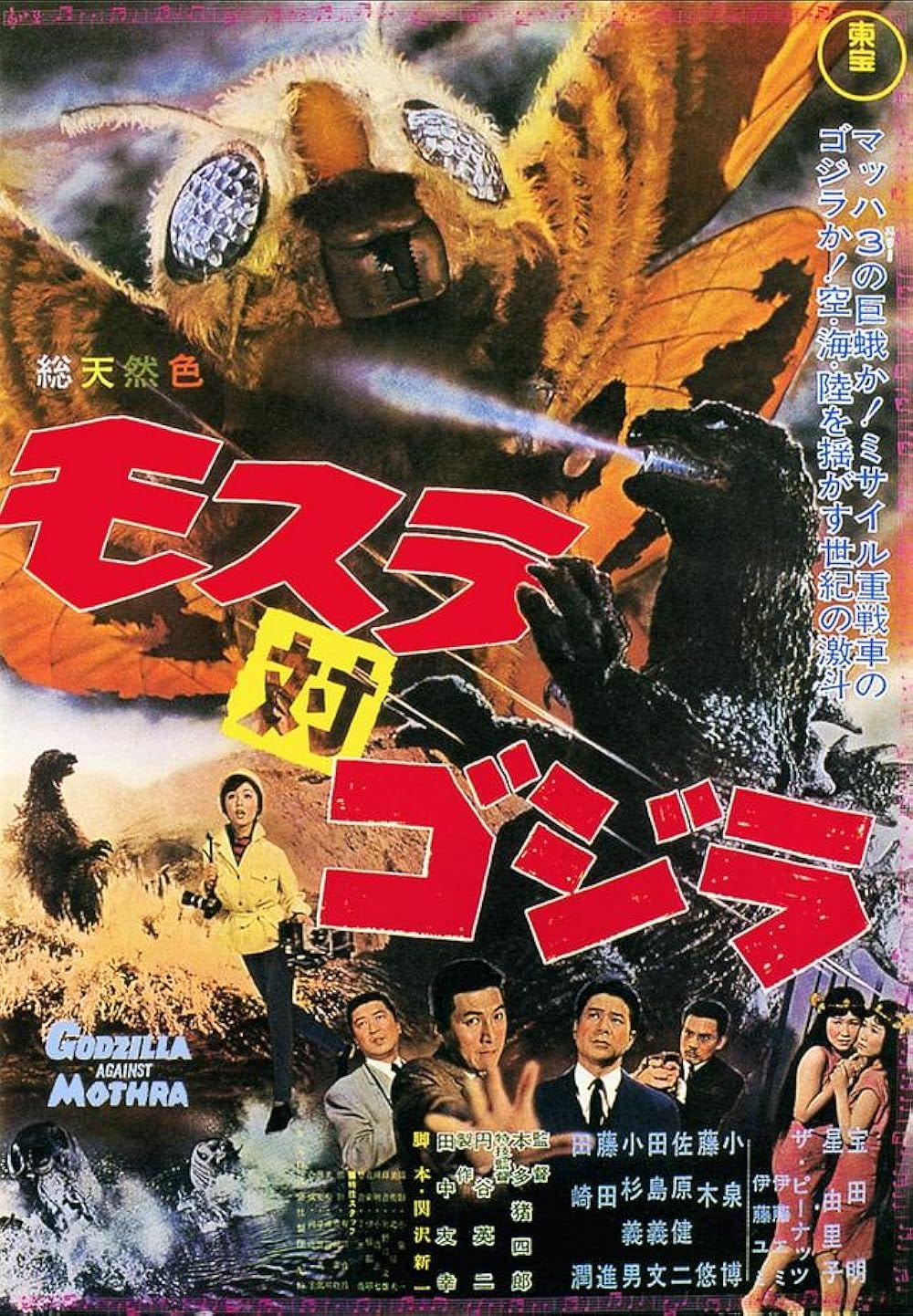
Mid-20th-century Japanese cinema has a none-too-scarce fascination with the decline/death of traditional Japanese ways of life in the aftermath of Hiroshima-Nagasaki. It’s true of Yasujirō Ozu’s touchstone Tokyo Story6, and it’s true of most every Godzilla movie that cares about being a Godzilla movie.
By 1964 in particular, America’s atomic thaumaturgy had long since ushered in a new status quo for both Japan and the world at large. And yet, the flow of nature held fast; where a hypothetical typhoon may have once slowed or neutralized a seaside variation of Project Manhattan and subsequently neutered man’s influence on the world, that same, now less-hypothetical typhoon (i.e. the one we see in Mothra vs. Godzilla’s opening frames) is now the nemesis of Japanese reclamation projects and the country’s industrial efforts, also neutering man’s influence on the world.
Put another way, everything is exactly the same as it’s always been; nature’s going to keep doing its thing in the face of every middle finger we give it, and we alone will shoulder the resulting identity crisis. I mean, you’ve got the Shintō priest offering prayers to the Mothra egg in a time where the Shintō religion has gone from its traditional roots in nature and decentralized polytheism, to an instrument of dedicated emperor worship during the Meiji era, all the way to this State Shintō dissolving into secularity in the aftermath of WWII. Meanwhile, Mothra vs. Godzilla will go on to be the final Godzilla film in the OG franchise to feature Godzilla as a straight villain figure. On all fronts, the scraps of precedence left by the atomic bomb — and normalized by this new era — are being pieced together in pursuit of some haphazard identity.
For the people of Infant Island — who have been devastated by Japan’s own nuclear testing; the most blatant snapshot of this cultural chaos if there was any — this seems to have manifested in a monotheistic tilt to their worship of Mothra, either because of how much distance has been put between them and the polytheistic roots of Shintō, or simply because the atomic testing has purged all the other worshippable kami. It’s telling, in any case, that Mothra is our narrative envoy for nature as deity, squaring up against the perennial reptilian allegory for mankind’s foremost self-destructive extracurricular.
Speaking of which, there’s storytelling heft in the lingering shots of construction equipment digging up land for battlements against Godzilla; the same reason that every military effort against Godzilla proves to be useless. It’s because military efforts against Godzilla are an ouroboros; industrial suicide redundantly bashing heads with more industrial suicide. All the while, the greedy businessman Kumayama is shot by his greedy financial backer Torahata, who tries to make off with the money before Godzilla rocks his shit with a collapsing roof. Birds of a goddamn feather.
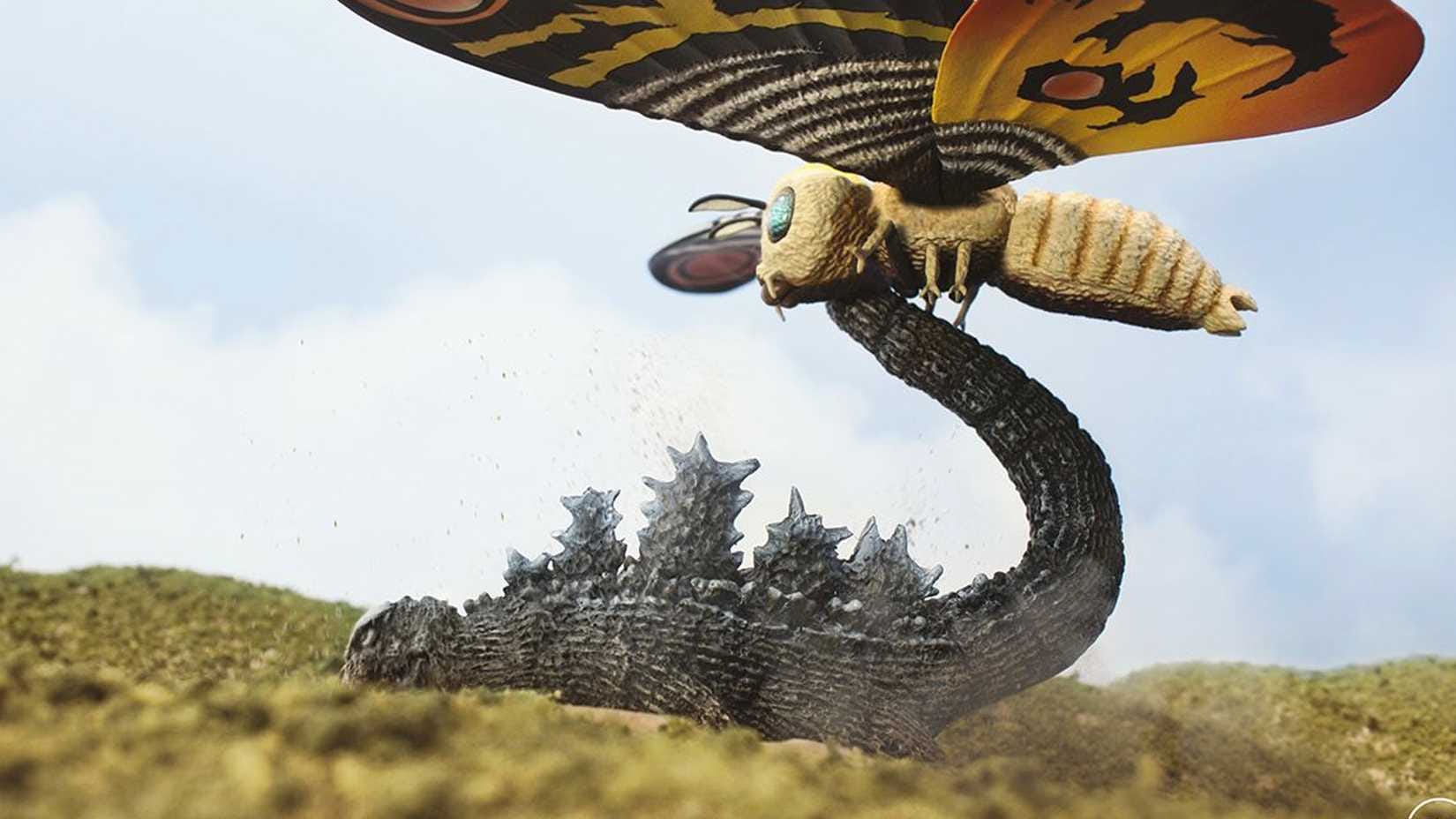
Now, at a glance, Mothra makes no great gains against Godzilla either, but then you realize that Mothra played a decisive role in pulling Godzilla off of her egg, protecting the offspring that will go on to actually be victorious against Godzilla.
It is in this beat — together with the subplot of the human protagonists going to rescue the schoolchildren on Iwa Island — that Mothra vs. Godzilla plays its royal flush. Mothra (i.e. nature) is not bound by the whims of man as the atomic bomb is, and enters the fray not out of guilt, empathy, hostility, or fear, but because this is simply what nature has always done: Act as the fact of what is, what will carry on with or without mankind’s cooperation. It is imperative, then, that humanity takes stock of what is — rather than what they wish would be — and allows these observations to lead whatever investments they make in the future, which begins with ensuring the lives of our children. And what better way to advocate for taking stock of what is than by making your protagonists a pair of journalists (Sakai and Nakanishi) and a scientist (Miura)?
—
Yes, the rubber Godzilla suit et al is obvious, but man, I’ll very happily watch these practical Harryhausen-adjacent VFX joints over modern Hollywood polish any day of the week. In fact, if we take Mothra’s lessons to heart and take stock of what is, we do much more for ourselves by watching the VFX as transparent craft instead of expecting realism from something that is not real. Would love to see a kaiju joint that makes full use of the slow cinema language that lies dormant here, too.
On another note, I haven’t watched any of the Rebirth of Mothra films and thus can’t speak to how well they fill this space, but we’ve had Peter Jackson’s King Kong and now Godzilla Minus One as modern, thematically-dense, standalone-continuity engines for two of the three most iconic monsters in the whole of cinematic fiction. Mothra’s gotta get hers soon if she hasn’t already. I’ll write it myself if I have to.
(not necessarily limited to boys and men)
There were a few small aspects that didn’t quite land for me personally, but this is the only one I can say anything tangible/meaningful about.
“Oh man! Is Maverick gonna make it back to base?” — Someone who has never seen a movie before.
I did see this in theatres, obviously, but I took in an afternoon showing in a small city, which pulled <10 people.
Take notes, Bear.
A movie I owe my life and career to.
The film broke in "Obsession" IMMEDIATELY after the scene in the car with the, um, head injuries. The lights came on. Total silence. Those people in the audience were MESSED UP.
Mothra vs. Godzilla was my favorite Godzilla movie. Still is although I have not seen it since I was a kid. All the Godzilla movies were the essence of humanity vs. the destructive instincts of humans. That conflict, the internal nemesis of any peace we may long for, is the stuff stories that only survive as long as we have imaginations.