
Köln 75
on German-engineered music biopics, scaffolding, and Curry Barker

Today we’re reviewing Köln 75, a 2025 German music biopic written and directed by Ido Fluk and starring Mala Emde as wunderkind music promoter Vera Brandes, who — at age 18 — played the central and decisive role in organizing a concert in the city of Köln for American jazz artist Keith Jarrett (John Magaro). The concert would go on to become Jarrett’s record The Köln Concert, the best-selling jazz record of all time.
I watched this on Kanopy. Brushes the avant-garde because of — rather than in spite of —how deeply it exists within its genre, which is neat even before those same bones foreshadow the text. Lightly educational and deeply metatextual, yet somehow not entirely my vibe. Emde’s wonderful and would thrive with a surrealist script, Magaro does that Magaro thing where he reinforces my Magaro bias. Recommend.

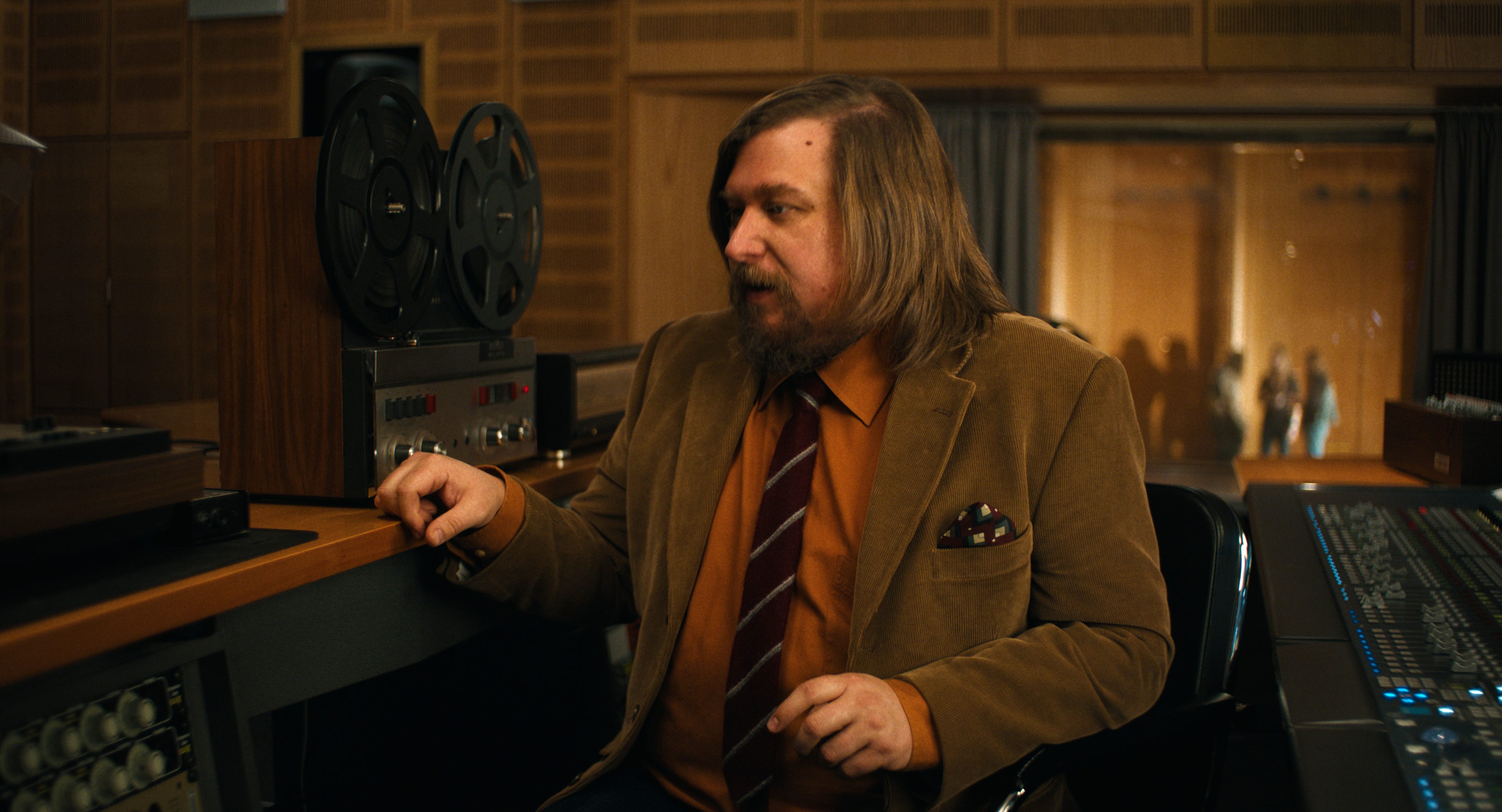
At Köln 75’s midpoint, the narrator — who we later learn is a fictionalized version of then-freelance Jazz World journalist Mick Watts (Michael Chernus) — serves up a crash course in the evolution of jazz, which he characterizes as “one long process of elimination”:
First was the big band, complete with solos — designated to the band leader — that were played within pre-defined keys or bars, themselves part of a fully prearranged composition/score.
Then the bands shrunk to groups of three-to-five, all of them improvising within a set chord progression and doing away with the role of band leader. Compositions still exist, but are mostly used as a blueprint for the band’s improvisation.
Then those bands got rid of the compositions, embracing total improvisation based on nothing but their chemistry; the “free jazz” stage.
Finally, we arrive at the territory that Keith Jarrett occupies. No other band members to improvise with or bounce off of, no prearranged composition on which to riff, not even a vague idea in his head of what he might play. He plays like this for an hour, night after night, and never repeats himself. Keith’s pedigree becomes effectively inextricable from his elimination of scaffolding…
…ignoring, of course, the fact that Keith’s most pronounced claim to fame prior to the Köln concert was the time he spent in Miles Davis’ band, to say nothing of Art Blakely, Charles Lloyd, Wayne Shorter, and the Columbia Records deal he coasted on before that ran out.
And indeed, Köln 75’s opening scene involves Mick daydreaming about what it must have been like to be there when Keith Jarrett played the Köln concert, or when Michelangelo perched himself on the scaffolding to paint the ceiling.
“That’s what this movie is about,” says Mick. “The scaffolding.”
Then we follow Vera for a crisp 45 minutes, from her humble beginnings as a gung-ho high schooler who somehow started setting up gigs for Ronnie Scott, to right before her Keith Jarrett-themed Sisyphus moment involving a broken, off-brand piano and a very unhealthy and cranky client made more cranky by said broken, off-brand piano. We follow her because Vera is, of course, the scaffolding of Jarrett’s late-career enterprise.

More interesting, though, are the nuances of Vera’s own scaffolding. A loan of 10,000 Deutsch marks from her mother gives the scaffolding its most physical shape, as do her school friends and partner that support her in any way they can. But the film also makes a point to highlight:
The role that Vera’s youth and beauty play in jumpstarting her odyssey,
Her political involvement in pro-choice marches, and
Her physically-and-emotionally abusive father happening to run an in-house dental office with its own phone line that Vera ends up relying on for booking early gigs.
In other words, the oppressive paradigms expressed within gender-sexual politics and the parental lottery nevertheless also house the very tools with which Vera becomes empowered to carve out this specific station for herself.
One might conclude — as one journalist’s remark towards Vera during an interview alludes to — that Vera ought to be grateful for the way women are regarded in mid-20th-century Germany, given the opportunities it led her to. But this conclusion depends upon the scaffolding of the fact that her life simply wouldn’t be the same — for better, worse, or otherwise — if the gender-sexual politics weren’t quite what they were. Same idea for if she were born to a different father.
Recognizing this, we can trace a hierarchical relationship between conclusion and fact; the privileged conclusion lording itself over the fact despite the latter being foundational to the conclusion’s relevance or even existence. Same idea with Keith and Vera, or any of the men like Keith whose exaltation by a hierarchy-accepting citizenry depends upon unsung humans-turned-circumstances (scaffolding) like Vera.
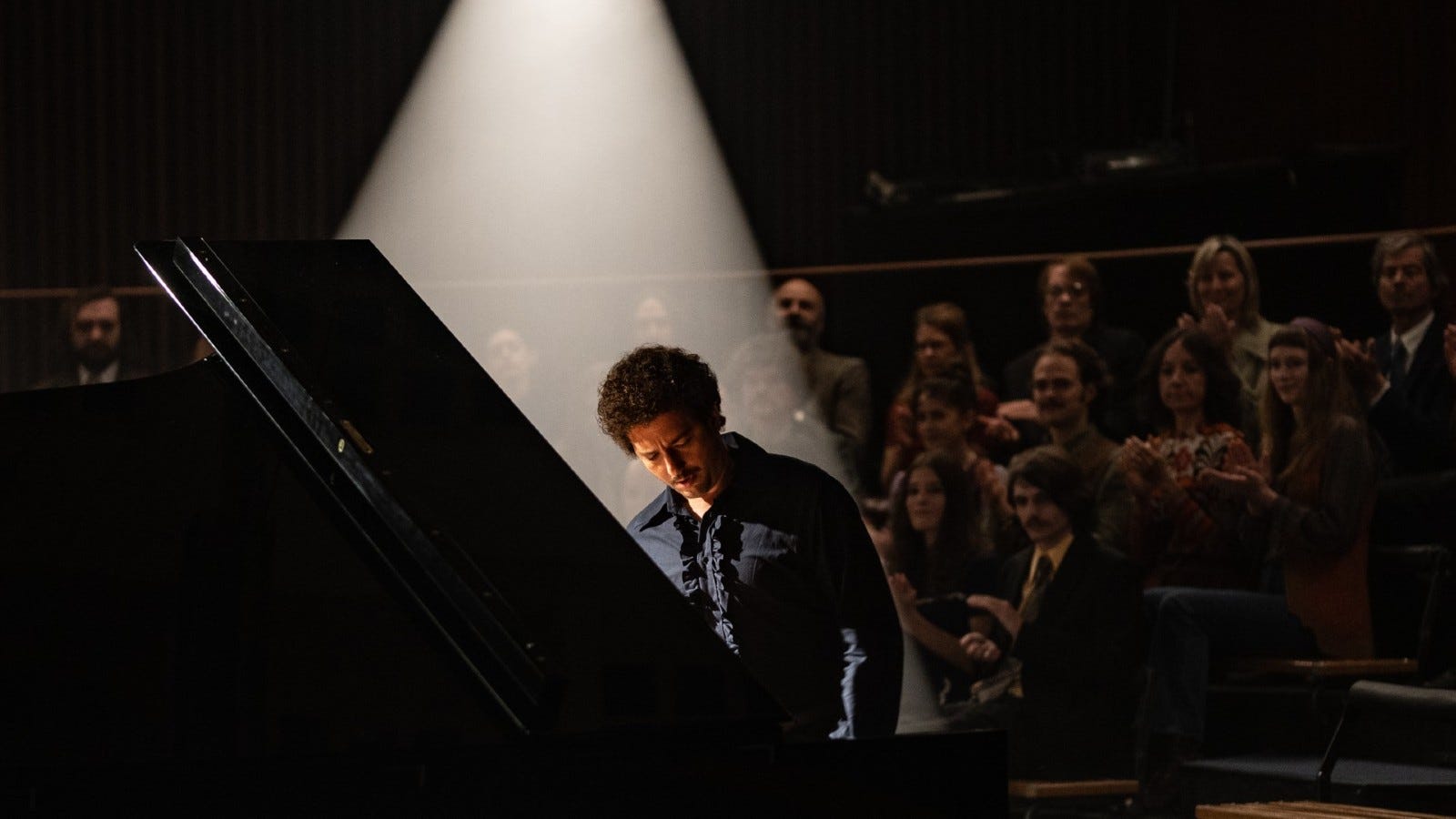
Speaking of Keith, he isn’t doing so hot. When we meet him at the film’s midpoint, his back is a warzone, he’s barely slept or ate, he refunds plane tickets and drives across Europe so that he has money during the tour, and he generally seems a long way away from the kid that Miles Davis had to chase down for recruitment. You might say his life would be very different — for better, worse, or otherwise — if he didn’t have those prodigal ears for the piano.
We also find out that Keith demands far more absences than those of pre-written compositions and band members. He forbids coughing and cameras during his shows and also avoids playing and listening to music in between concerts, lest the noises weasel their way into his head and affect the music. Indeed, Keith wants pure music, pure space to pull from; space not even touched by human thought, music completely defined by total detachment from its history and taking pride in its isolation. And it’s definitely a coincidence that Keith is completely fucking miserable, guys; trust.
Anyway, Keith has just finished a concert in Lausanne and is about to leave for Köln with German record producer Manfred Eicher (Alexander Scheer), and Mick, who gets a ride with them on the condition that he doesn’t interview Keith during the trip.
What follows is a plotline chock full of anecdotes from Keith that Mick — on more than one occasion — geeks over how good they’d be as writing material. One such geeking takes place after the following exchange:
MICK: And music can wake us up?
KEITH: Maybe that’s what good music can do.
MICK: But when you play, you seem to get lost somewhere. You go someplace. Isn’t that the opposite of being awake?
KEITH: Maybe we have different definitions of what being awake is.
In the next scene, Manfred falls asleep at the wheel — closer to Keith’s definition of being awake than Mick’s, if you ask me — and almost gets him, Keith, and Mick killed.
Importantly, Manfred will later lament to Mick that no one back in America seems to care about Keith’s generational talent because the culture sees his music as obsolete, hence his getting dropped from Columbia. He follows this up with a remark to the tune of “In America, the business consumes the artist. In Europe, we still value them.” He says this because he’s asleep to the law of scaffolding.
Check it: Keith’s value — arguably the very idea of it, but certainly the worldly translation of it — depends upon a scaffolding to allow it to exist. That scaffolding is the American public/cultural zeitgeist, which is not owed to Keith any more than Vera’s youth and beauty are owed to her. Thus, Keith proceeded to seek out whatever scaffolding would allow his value to be reinstated; it just so happened that that meant going overseas and scrappily hammering out concerts, the most important one — the one that will ensure “Played for Miles Davis” isn’t the thing that gets written on his gravestone — coming to him by way of the thankless tenacity of an 18-year-old girl who is “used to dealing with narcissistic men.”
We inevitably arrive at the afterword you find in most every biopic: “Widely regarded as a masterpiece, it [The Köln Concert] is the best-selling solo jazz record in history” (emphasis mine). Not a word on Keith himself. Then, we get a brief spiel on how Vera would go on to start a music label and organize hundreds of tours, live concerts, and records, closing on a gag reel of the two actresses1 who played her — along with the real-life Vera Brandes — laughing together after all three fail to whistle.
Prior to that, we find out that Mick submitted a story to his editor about the aforementioned car ride he took with Keith and Manfred. It’s in this same moment that we find out that Mick made the entire sequence up. The car ride — and all of the Keithisms that Mick was glazing — never actually occurred.
I say all this to unoriginally pose the following: Are notions of artistic greatness not primarily utilized to subliminally reinforce the antisocial, patriarchal, and dollar-centric paradigms of Western caste, while — on a less material level — reaffirming those who benefit from or at least build their ego upon these hierarchies that package said notions in men like Keith, who themselves, in actuality, owe their mobility and relevance to the unsung labour of those that the caste devalues; in this case, women, and in a more broadly historical case, Black people?
Is it not striking that Keith’s — a white guy’s — significance is rooted here in the dissemination of a music genre that originated in African-American communities, and which resident Keith Jarrett glazer Mick describes as “not even jazz anymore; just pure music” (emphasis mine again)?
I don’t know, man, I think we lose the plot on art and music when we attach it to some colonially-curated scale of greatness that — even if it doesn’t isolate and embitter the vessels of said greatness like it did with Keith — claims to serve its witnesses by affirming their value on the basis of their attunement to/exaltation of the “correct” kind of art.2 Keith believes that “good music” can wake us up, but I’m not exactly counting on those who can regularly attend the ballet and opera showing up as the vanguard for pressuring systems of power. But then, Keith and I probably have different definitions of being awake.
I want to expand on this with a real-world tangent rooted in the current moment. Ever since Obsession landed in theatres earlier this month, I’ve encountered the odd remark questioning whether or not Curry Barker deserves the opportunities he’s getting, referencing the resources and circumstances he was and continues to be surrounded by, contrasting with questions about his compartmentalized ability as an artist, the unprecedented successes of Obsession, and the fact that he’s since been handed the keys to A24’s Texas Chainsaw Massacre film.
Now, in case I haven’t been clear enough already, I believe he absolutely deserves what he’s getting, but I primarily struggle to even accept the question as a serious one, given how disturbingly incurious it is about the scaffolding that allows the question — whether applied to Curry or anyone else — to even exist.
Thus, I want to examine that scaffolding, which I can do by giving my actual answer to the aforementioned question:
Q: Charlotte, do you think <public figure who makes art for a living> deserves to be in the position they’re in?
A: I think everyone — everyone — deserves to transcend the need to survive to the point where they have freedom to ruminate on their human element and subsequently nurture and express that in art or in creation of some kind. The “who deserves” part of the question is only relevant if the act of or proximity to creation depends upon your position in/usefulness towards a caste, which I, for one, don’t accept as a premise worth basing our reality/lines of questioning upon.
Now, I can of course acknowledge that class-hierarchy is part of the world we live in, and that my rejection of the question is a conclusion that depends upon the scaffolding of the precedent of class-hierarchy. But can we also recognize that class-hierarchy — together with what and who it canonizes as valuable — is itself a conclusion that depends upon the scaffolding of the fact that A.) Humans exist, and B.) There is an endless gradient of human expression? Something something facts something something logic.
And I think that’s all I really have to say about that right now.
An older version of Vera is also played by Susanne Wolff
Mick, by the way, offers Keith some light criticism of the Lausanne concert and gets snickered at.