
Sew Torn
and why I'm doing what I'm doing

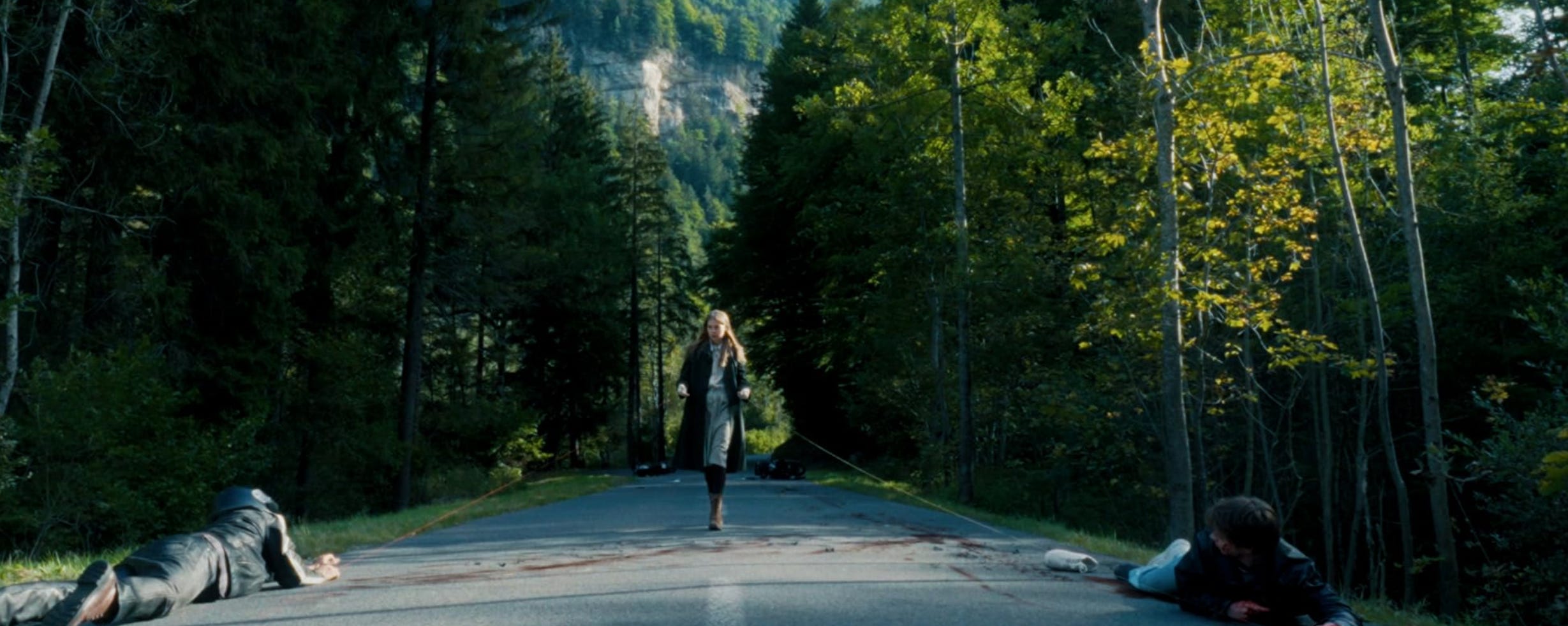
Today we’re reviewing Sew Torn, a 2024 crime thriller and SXSW darling directed by Freddy Macdonald, the youngest director (at age 25) to ever be accepted into the American Film Institute. Co-written with his producer father Fred Macdonald, it stars Eve Connolly as Barbara, a grieving seamstress who’s been struggling to keep her family shop open ever since the death of her mother. When she encounters a drug deal gone wrong and a briefcase of life-changing money up for grabs, she finds herself at a triple-pronged fork in the road: pull off the perfect crime, call the police, or drive away. Choices, choices, choices…?
You can tell it’s a debut from a twentysomething, and you can tell it’s a feature adaptation of a short film; I don’t think that’s a bad thing. Its singular MacGyver-esque bread-and-butter cheats a bit and is better for it in the way that matters most. And even among that, the emotional literacy is by far its richest element. Works with levels, works without them. I’d tuck into Sew Torn any day.
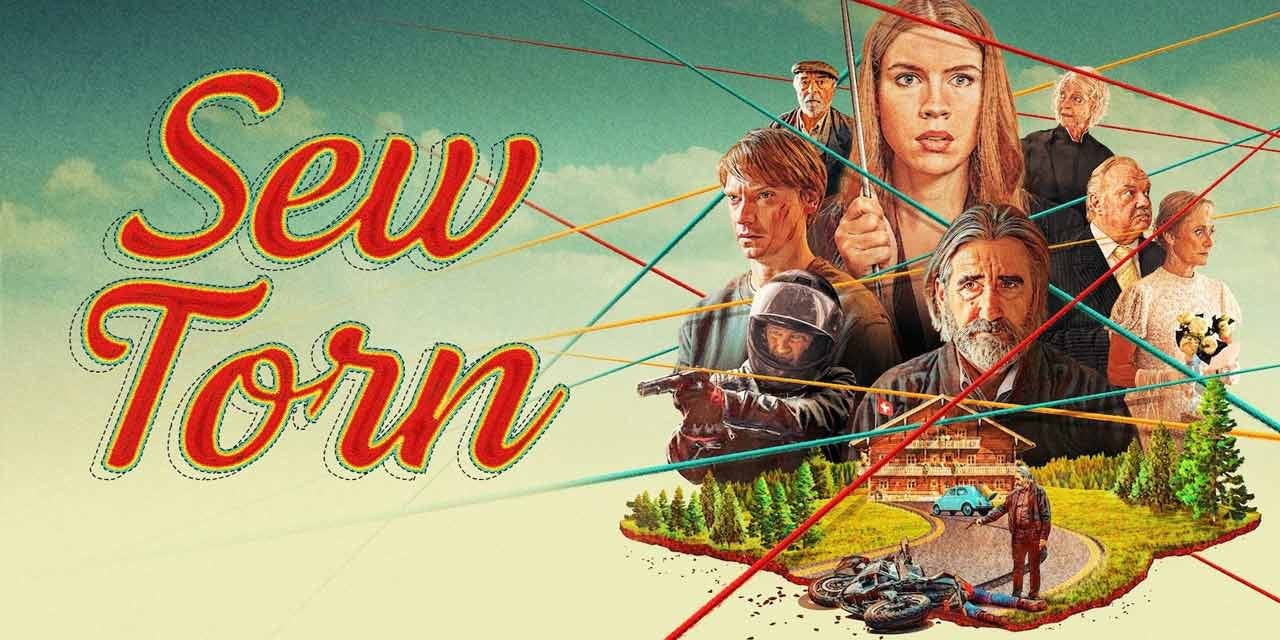
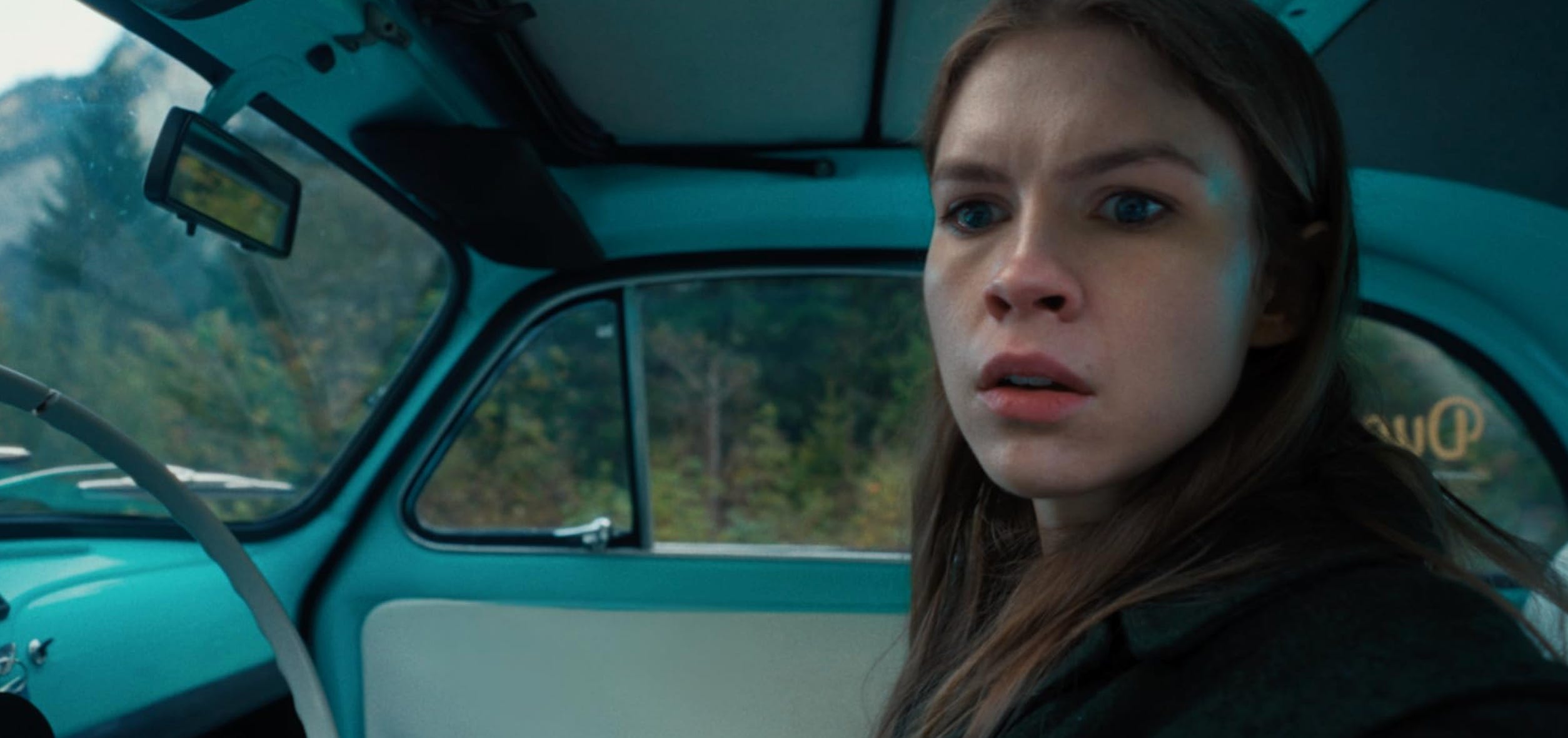
When we first meet Barbara, she’s in the middle of a strikingly maladaptive wave of grief, having built a house-spanning spider-web of pullstring soundchips that spout audio recordings of her and her mother in the middle of what sound like happier childhood memories.1
But then we get a glimpse of the town; tiny, colourful, where its police chief has two other jobs and everyone knows everyone by their first name. Immediately, the intensity of her coping mechanisms2 are accounted for. This is a safe Swiss marshmallow where nothing happens; nothing bad, nothing good — just a frictionless, G-rated hideaway where your family is both the centre and periphery of your universe. Comforting for mothers of small children, especially if they’re disinterested or actively hostile towards the notion of said child developing their own sense of self. The child — helpless in their lack of self-alignment — goes along with it because there’s nothing else to go along with, and then suddenly Mom is dead and the child is 25.
Indeed, the tragedy began at Barbara’s birth.
As we make our way through the triptych, the layers and nuances of Barbara’s grief are pulled back; she was watching her mother drink herself to death, she thought about leaving her mother but never found it in her to do so, she listened to her mother tell her that she would end up just like her, and she doesn’t even like being a seamstress — it’s simply all she’s ever known, it being a mother’s-footsteps occupation that also serves as the foundation for her inventive, thread-centric contraptions that make her competitive against drug dealers while also obviously serving as the marquee element for audience endearment.
And therein lies the hidden narrative nutrition of Sew Torn’s crowdpleasing nucleus; we may be so busy scratching our Home Alone itch, that we don’t notice the ways in which Barbara’s use of thread clue us in to her psychology.
This is a woman who thinks very mathematically, who can look at the world around her and know exactly how to apply her sewing-themed physics engine in pursuit of her goals. She knows the capabilities of these threads — these materials — intimately, and can wield them ingeniously.
But then, of course she does, and of course she can. Living under her mother in an environment with no other contexts for her to engage with, it was almost inevitable that her imagination would be entirely colonized by the threads; she knows just one thing, and knows it perfectly. Her intimacy with the threads — the film’s central entertainment hook — are a reminder of her torture, because a sewing-themed physics engine in your brain isn’t much good if you have no goals to pursue.3
Maybe we enjoy watching Barbara set up her contraptions and how they play out upon the proverbial pull of the trigger, but are we prepared to reckon with the fact that this inventiveness — this key element of the film that endears us to Barbara — both reflects and hides an insidiously suffocating trauma? One that her mother most likely tried to hide from everyone?
Aren’t you just so torn?
Indeed, the threads leave no room in her mind for possibilities beyond them or the shop. It’s why she can’t imagine surviving any of these scenarios. It’s why she cannot imagine the head dealer, Hudson (John Lynch), maliciously greeting her in any way other than “Mobile seamstress? Not so mobile anymore.” It’s why the only other young person in this film — Joshua, the young man involved in the handoff-gone-wrong and the son of Hudson — is also trapped by the shadow of their parent, because Barbara can’t even imagine a person her age who isn’t in this position.
And when Barbara’s sewing contraptions strain credulity, you have to remember that this all takes place in Barbara’s imagination, and that physical matter (i.e. the threads) has objective limits that consciousness of possibility — alien to Barbara — does not. Each time the film tests our suspension of disbelief (which will vary from viewer to viewer), it’s bumping up against the very strict boundaries of Barbara’s imagination, defined entirely by her depth of thread manipulation, illiterate in the language of freedom.
So I ask again, what good is thread savantry if it means you can’t even be yourself? What leg can you stand on once you’ve reached the limits of the thread, co-opted here as your own limits? Coast on winning the approval of neighbours? Audiences?
In the third segment, when Barbara and Joshua are trapped at a diner table with Hudson, Barbara’s escape plan requires her to move around the diner to set the threads up in a certain way; something she can’t just go and do with Hudson watching her.
Her solution is to open her sewing kit/music box that plays a song about sewing machines sang by her mother, and use the song to dance around the diner — much to Hudson’s surprise and amusement — while discretely setting up her threads. The dance is comprised of aggressive, effortful thrashing and graceless destruction/disruption of the diner, Barbara performing it with a hardened face and initiating it with a standstill flourish, as if letting the song enter her body before it takes over. By all observations, she endures the dance.
It’s a moment that seem like an eccentric setup for another Rube-Goldberg payoff, but if you really read it, it expresses profound horror. This is Barbara at the absolute limit of her imagination, believing that the only way she can get out of this situation is if she halts all resistance and completely gives her body over to the very hereditary banalities — taking their form here as lyrics about a sewing machine being a girl’s best friend — that actively prevent her from imagining life beyond the sewing shop, the town, her mother. And the act of dancing, so often understood to us as a vehicle of dynamic self-expression, is a quality underlined here by the very absence of it; Barbara’s dancing cannot be a form of self-expression because she has no self to express. Even in death, mother’s permission is a necessary ingredient, and we see in Barbara’s face and movements how discordantly it lives in her skin, especially when she gives it carte blanche as her final lifeline.
It’s an invariably textured set piece in a film that hinges on set pieces, and perhaps speaks most directly to Sew Torn’s overarching melancholy towards the darkness that can underpin the veneer of whimsy in so many lives and families. The aesthetically-inviting colours of the town, the crowdpleasing Rube-Goldberg choreography, the quirky dance; all these surface-level expressions of Sew Torn want to win your approval in a none-too-different way that any given small-town family is eager to win the approval of their neighbours.
And indeed, it seems at first that Barbara is the product of a wholesome, loving mother-daughter bond that probably charmed all the church ladies and sparked envy in other families. But once we actually get to know Barbara, it’s clear that the ghosts of emotional stunting were ravaging her long before her mother died, and became especially ruthless behind closed doors.
And that’s mostly all I have to say about Sew Torn. It’s a shorter review living in its own post; maybe one you could read over a cup of coffee, or whatever other case-utility a short review could take advantage of and thereby justify itself in a newsletter that’s not terribly comfortable with the precedence of brevity4. Maybe that discomfort is important.
Weeks ago, though, I would have packaged this with two or three other films in a Doctor’s Notes post, and then spent the next week prepping another; scouring my backlog for the next cinematic equivalent of a collateralized debt obligation to my Wednesday-centric schedule, my reliably feature-length word count, and — I suppose — my readers, even if I can only comprehend their expectations in the vacuum of my self-imposed routine, which probably doesn’t amount to a very accurate comprehension.
Anyway, that’s how the The Treatment’s been rolling for this last while, but it is a playbook I will henceforth be departing from. Here’s why:
The weekly-post schedule creates a routine for me. Most people find comfort in routine; I, for the moment, do not. A routine creates a shape for my life, realizes some approximation of finitude within it, leaving less room for the accommodation of welcome disruptions or sudden opportunities. A lack of a set schedule gives me freedom to steer The Treatment on a dime, and — as you’ll see within the timeframe of soon-to-very-soon — it’s very important that I’m able to account for off-schedule programming on a whim. Plus, I’m always harping on the dangers of building one’s experiences around expectation; I might as well adopt a modus operandi that discourages that.
A shape, by the way, would be less scary — even preferable — if I had a life that was my own, but I don’t have that yet. Most everything I do is derivative of an overarching scramble in pursuit of establishing some station for myself that I haven’t really had since I got laid off and had to move home last year5. I am, for the record, possessed of the most ferocious faith that the trajectory I’m on will lead me to the life I want. But until that happens, my body will continue to be the site of a very mammalian and equally existential anxiety that will only skyrocket if I entrench myself in the complacency of a routine right now.
I choose to see the inside of my head as charmed, but it is an exhausting place to live, especially when I’m juggling the storytelling nuances of multiple films every week while also trying to save some neurons for all the other things I’m working on behind-the-scenes/off-Treatment, not to mention the fact that my main leisure activity is reading, which draws demands from the same space. And all of that — the charm and the game of neuron management — is multiplied by the factor of my bipolarity. Bottom line: Dedicating more frequent, seat-of-my-pants posts to one film at a time will simply make me infinitely happier (for lack of a better word) at the most marginal cost to my aggregated content output. With time, I believe this will benefit the writing itself.6
So yeah, this is me now. I suppose — reading this post back — this approach has a third boon in that it gives me space to just riff with a more directly personable edge or veer into other topics if I feel like it. Given how much I dislike Notes as a forum for expressing myself, I can see this happening often.
The Drama is coming soon, but it probably won’t be my next post.
In any case, see you in the stitches,
— C
Immediately, we’re clued in to both Barbara’s inventiveness with sewing threads and the emotional core.
And they actually are mechanisms! Ha!
In pseudoscience, we’d say that the left hemisphere of her brain has won the war against the right hemisphere.
This, despite the fact that this newsletter originated with very short, very commercially-informed film reviews that don’t at all reflect the philosophy I hold myself to today.
Those two events happened in the opposite order; it’s a long story.
Also, to the prior footnote, I started The Treatment back when I still had a station for myself. Might the instinctually-imagined shape of this new playbook for The Treatment — identical to that of the newsletter’s shape when I still had steady income — indicate the doorstep-darkening advent of a new station, a new life that I can call my own? The prodigal geometry, returning with contents that have matured so far beyond its dreams of yore, ready to be completely itself. The poetry of that would keep me grinning for the rest of my life.
Full disclosure, I wrote this piece in a day, and I think that’s apparent. This will not be the norm (the circumstances that led to me writing this in a day are quite extraordinary, as a matter of fact), and I intend to make that equally apparent in future posts.
here's to happy-making, as best you know how. love your posts, epic expositions or otherwise.