
Doctor's Notes: F1, Hamnet, Twinless, and The French Dispatch
Cars, twins, journalists, and the plague

Welcome to Doctor’s Notes, where I — Charlotte of The Treatment — share some shorter but still Treatment-coded reviews for films I’ve watched lately. This will largely comprise recent and more commercial films so that I can keep my foot in the Rotten Tomatoes door while also introducing the widest possible audience to the New Film Criticism.
If you’re coming here from Rotten Tomatoes, know that “Fresh” and “Rotten” ratings indicate my personal enjoyment of the film only; they are not a testament to whether or not they’re worth watching. If I write about a film, that means I consider it worth watching.
I give star ratings for every film I plan on including here over at my Letterboxd account, where these reviews will then be posted after the Doctor’s Notes post goes live. Follow me to get a sneak peek at what I plan on writing about!
Table of contents:
F1

If there is so much as a fracture in whatever keeps you insulated from the world, you are equipped to zoom out (or whatever the opposite of squint is) and effectively recognize F1 as a horror movie. Much has been said already about its blatant worship for the eponymous, high-octane, multi-million-dollar corpo-cocoon that has long coddled a subsection of the transnational old boys club, whose continued relevancy comprises all three wishes that this film — and, by extension, the men who fantasize about getting a foothold in these long-standing structures of power — is making to the genie’s lamp. Much has been said already about how this is underscored by Joshua Pearce (Damson Idris) personifying modernity as understood by such men; that is, a self-righteous, silver-spooned, insecure homunculus of hostility that needs to learn its place, and perhaps a few lessons from these men. Much has been said already about how everyone’s characterization is one of convenience for the fantasy of power-hopeful men, packaged together with the banally unserious stakes of an older white guy’s sense of pride that allows itself to be defined by the gaze of a resource-boiling spectacle of industry.
And look, it’s not like the film ever pretended to be about anything else, but that’s also just it; F1 buys so deeply into its six-cylinder haze of cultural dissonance that its many displays of self-expression can be easily mistaken for a mockery of its entire prerogative.
To illustrate what I mean, there is literally a line of dialogue in this movie that, almost verbatim, goes “He passed his entirely self-imposed test by 500ths of a second,” he being Sonny Hayes (Brad Pitt), who just crashed the car during his APXGP audition and is now being told how awesome he is.
That is natural-born satire precisely because it’s not satire at all. You simply cannot kick off the meat of your plot with such verbosely cocksure swaddling of white mediocrity and not expect me to frame the movie through a satirical lens as a coping mechanism if nothing else. I would have stubbornly canonized this as an expensive lampoon if Top Gun: Maverick hadn’t come out years earlier.
With all of that said, there’s a cut of this movie that does work, and it’s actually not far off from the one we got; a sprinkle of self-awareness and a few tweaked-to-shaved subplots, and you’re off to the races.

Let me explain: When a show or a movie is produced with the intent to sell a game, the plot tends to be driven forward in part by the characters verbalizing the game’s rules and coming up with/commentating on strategies in real-time so as to explain the thinking behind gameplay decisions in pursuit of the game’s objective.
F1, an Oscar-nominated advertisement for the auto-racing sport, does exactly this; Sonny and Joshua strategize with slipstreams and positioning and the whens and whats of making pit stops.
My game design brain was mildly entertained by this, but that’s beside the point. The infrastructure of the game medium is entirely grounded in logic with no regard for any emotional element, and is therefore a product of amorality. That is not a value judgement; a game’s prioritization of outcomes, mechanical value, and our submission to an unfeeling goal is simply the craft. What’s detrimental to matters of human prosperity is preferable in matters of creating games (literally, challenges).
And so for a film like F1 — so cartoonishly submissive to this world of expensive egos and stentorian glitz that could never justify its upkeep requirements in any broader socioeconomic/political context, of which this film would pull the mother of all white-knucklers to steer clear of anyway — to dedicate a fair stretch of the plot to teaching the strategies and logic of Formula One as a game, is to engage in behaviour that’s entirely harmonious with the non-entity that is this film’s human element; amorality of game, meet amorality of oligarch-backed corpo-exhibition, artificial glory (so, in essence, glory), and probably GDP growth too, just while we’re at it.
You see? It’s a nugget of cinematic workability that is — as far as I can see — native to F1, and so I would be remiss to not call attention to it, since I believe in defining movies by what they are and do, rather than by what they are not and don’t do.
Of course, to that very point, F1 also knows exactly what it is through-and-through, and it’s something that I have a similar responsibility — as a critic and, in this case, a humanist — to tear down with impunity. Is it less insidious on account of that honesty? I don’t know. I suppose the stomach-churn of F1 is different from the stomach-churn of something like The Art of Racing in the Rain. If anyone wants to unpack that in the comments, go right ahead.
Twinless
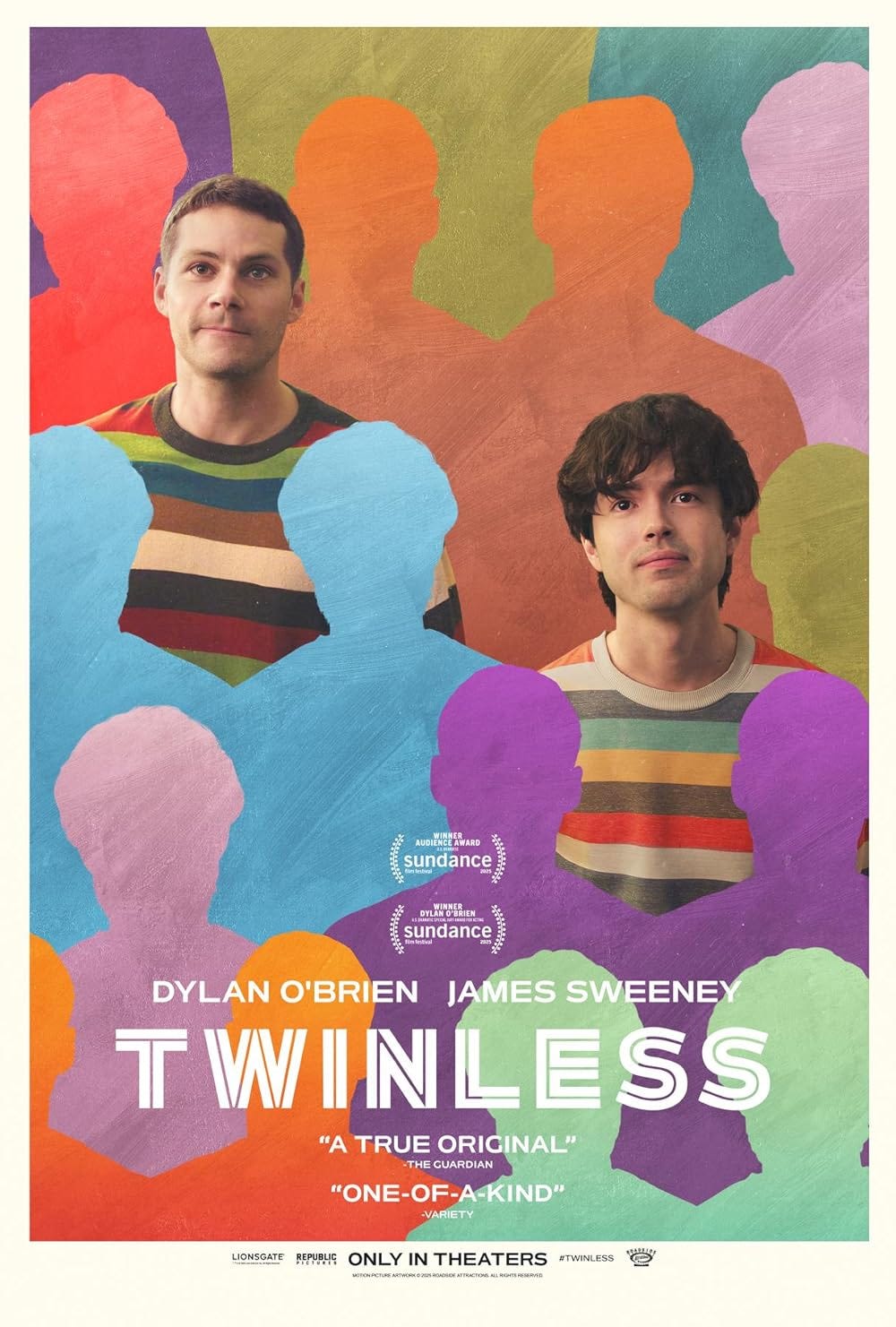
I don’t believe in spoiler warnings, so please understand just how big of a deal it is that I’m giving you one for Twinless right now.
Last chance to skip to The French Dispatch or Hamnet if you haven’t seen Twinless yet!
Okay, now…
Early on in the film, as Dennis (James Sweeney) is teeing up his empire of fibbery, he remarks how he likes feeling the pain of having lost his (fake) twin Dean, because if he stops feeling it, it means Dean is really gone, and Dennis will be officially, irrevocably alone.
I think as queer people — just as people with gone-too-soon loved ones, as men who fall for hegemonic gender traps, as human beings who simply had a bad roll with the dice of social providence — we have a tendency to regard loneliness similarly, because at least romanticizing your loneliness is a choice you have the power to make by yourself. You have no such power over actually relieving your loneliness; not really.
Because the regular, degular truth of the matter is that having any sort of relationship with somebody requires someone else to make that choice with and of you. You can’t control that, and if you try to, that defeats the purpose of choice, which defeats the purpose of a relationship. It is a completely helpless position that we’re all in; the best you can do is to live in honesty with yourself and become someone you like, but that won’t guarantee the kinship we’re all secretly desperate for; a desperation that grows in kinship’s absence.
And when you’re desperate to relieve loneliness, sociability is liable to come from a less-honest place. What would ideally be a matter of recreational curiosity becomes a matter of near-literal survival, and suffice to say that’s a lot of pressure — pressure imbued in the five text messages you send to Rocky (Dylan O’Brien) asking if he wants to get lunch that week — for another person to bear, especially when they have no responsibility to bear it. So of course they avoid it.
And if you’re constantly anticipating survival mode, which Dennis is, then you’re constantly preparing; stockpiling resources to live another day in someone’s orbit, their departure akin to death by hydration on a desert island: A wig so that no one will recognize you at Rocky’s funeral. A mental map of Roman’s (also Dylan O’Brien) routine. A fabricated mythology for your fake dead twin Dean. A pretense that you and Roman have a dead twin in common, which leads to you two getting lunch.
Turns out, Roman isn’t terribly dissimilar from you. He’s happy to declare that “You get me,” after you accomplish the very elementary feat of making him chuckle. Premature declaration, but an understandable one: It’s probably more than most anybody else has done for him in a long time.
Suddenly, he’s your friend. You’re actively in survival mode rather than just anticipating it. Prep is over; time to think on your feet. Put on a British accent, deepen the mythology, deflect where possible, wave away the unending influx of proof that you and Roman are not on the same wavelength and have very little compatibility as friends, because dammit, at least you don’t have to get groceries alone anymore.
Then Roman meets Marcie (Aisling Franciosi).

Let’s be clear about something: In a story like this, there are no heroes. No one saves the day. There can only be villains, victims, and victors, and the victors were simply former victims or villains lucky enough to find gerrymanderless kinship with another victim or villain.
Dennis and Marcie are both villains with just a few separations between their respective darknesses. Where Dennis is desperate for somebody to like him, Marcie is desperate for *everyone* to like her. She overplays the pleasantries and sympathies while affirming, affirming, affirming. She wants to be accessible. She’s obsessed with Olive Garden. She wants to be for everyone.
She says she loves people, but really she’s obsessed with them. An obscure, offhand detail about Dennis from years ago becomes a persistent line of questioning becomes phonecalls to old classmates because she has no business of her own to occupy herself with. Lives become recreation, personhood an object of consumption; every bit the disregard for sovereignty that characterizes the upper poisons of loneliness.
When she confronts Dennis about the lies he’s telling Roman, Dennis laments that she’s needlessly usurping his social life when she already has all the friends she could ever need. Except, does she? “I’ll just stand here,” she says to Dennis at the office party, looking anxious as he goes to refill a plate; the anxiety of someone in survival mode. And of course she is; her sociality stems from the same desperate obsession as Dennis’.
We can dish on who deserves more condemnation for mishandling their demons (Personally, I think Marcie), but the point of this whole dynamic is to recognize that, when you are desperate to have someone (and/or everyone) choose you — socially, romantically, whatever — the only individual power you have to relieve even some of the symptoms is to be dishonest, which will only exacerbate the disease. Actual relief depends on being chosen. Rescued. And there are no heroes in this story.
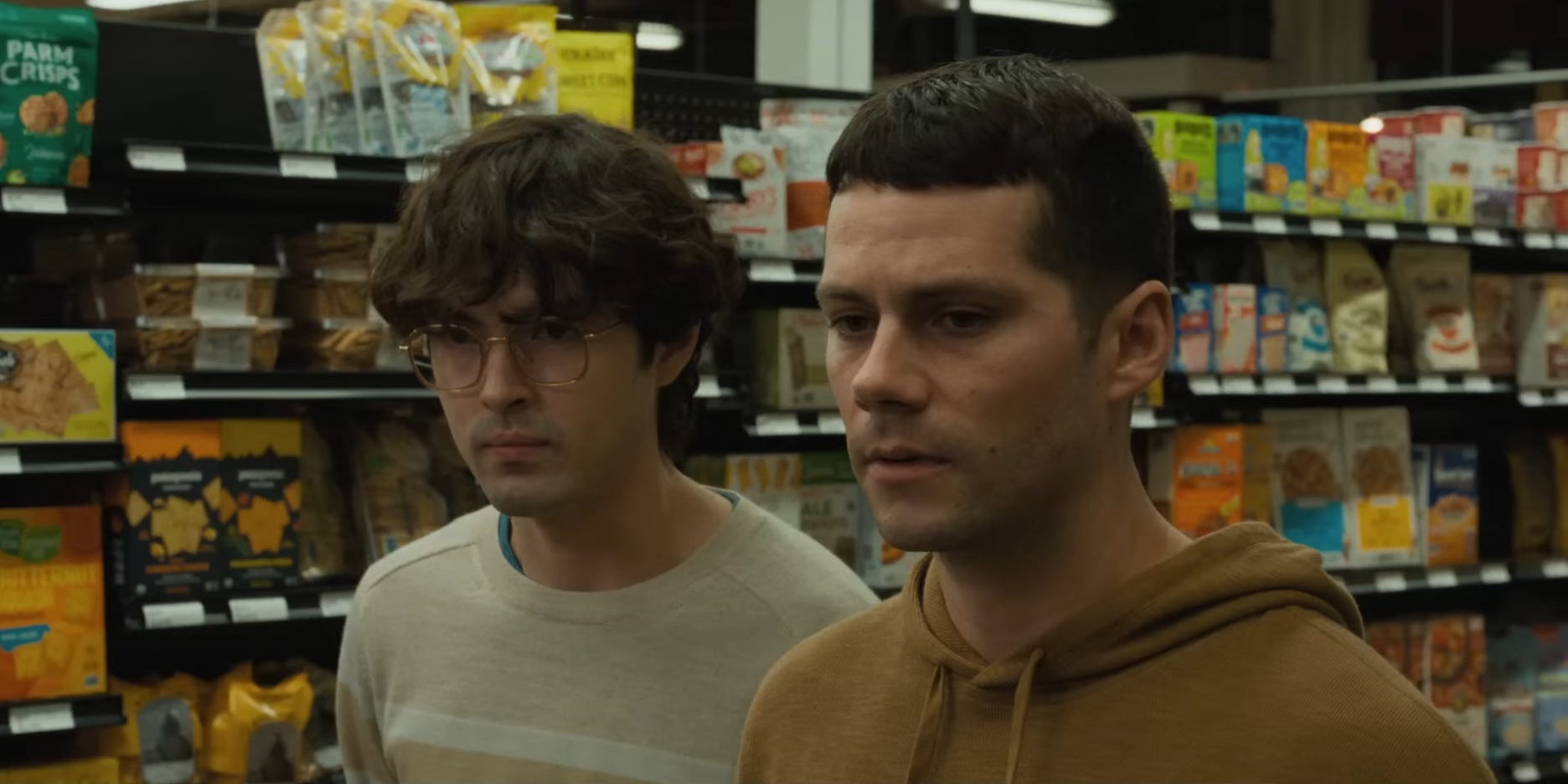
Roman is saved from villainhood by the simple fact that he makes no attempt to relieve his loneliness. He’s going to hell and he’ll keep going, until Marcie changes that “to” to a “through.” He is spared, but no less vulnerable to the definitive helplessness of loneliness; Girls Night is just the first crack in the lucky porcelain pot that’s containing Roman’s neediness. They will probably break up over Roman’s temper, and Roman will probably work on himself, but however much he succeeds at helping himself will have no bearing on whether or not he gets chosen by someone else in the future.
And so how else can Twinless end but with Roman and Dennis sitting there, having lunch, knowing that they’re just two socially incompatible people who could never — not with all the empathy in the world — relieve each other of their loneliness? You find your person/people if you do, and you don’t if you don’t. Dennis hasn’t, and Roman most likely hasn’t either, and neither has any power to change that. Their pain is the same, their helplessness is the same, and the final line they each speak in the film is — literally and therefore symbolically — the same.
I think the foremost poetry in Twinless lies in the fact that, with this plot that depends upon dishonesty from its characters, it reaches a level of honesty that most films do not. A lesser film would have ended on a note that peddles hope, as if hope is a thing that a film can feel, and as if hope isn’t the responsibility of us humans to create and commit to.
Twinless clocking the truth of this helplessness is only feel-bad pessimism insofar as we accept feel-bad pessimism as the only conclusion for knowing this truth. By being completely honest with us, it exhibits confidence in both itself and in our ability to respond to it, and subsequently gives us the grace of total freedom to draw what conclusions we will with this information; a grace that Dennis didn’t give Roman. Look how that turned out.
Well?
The French Dispatch
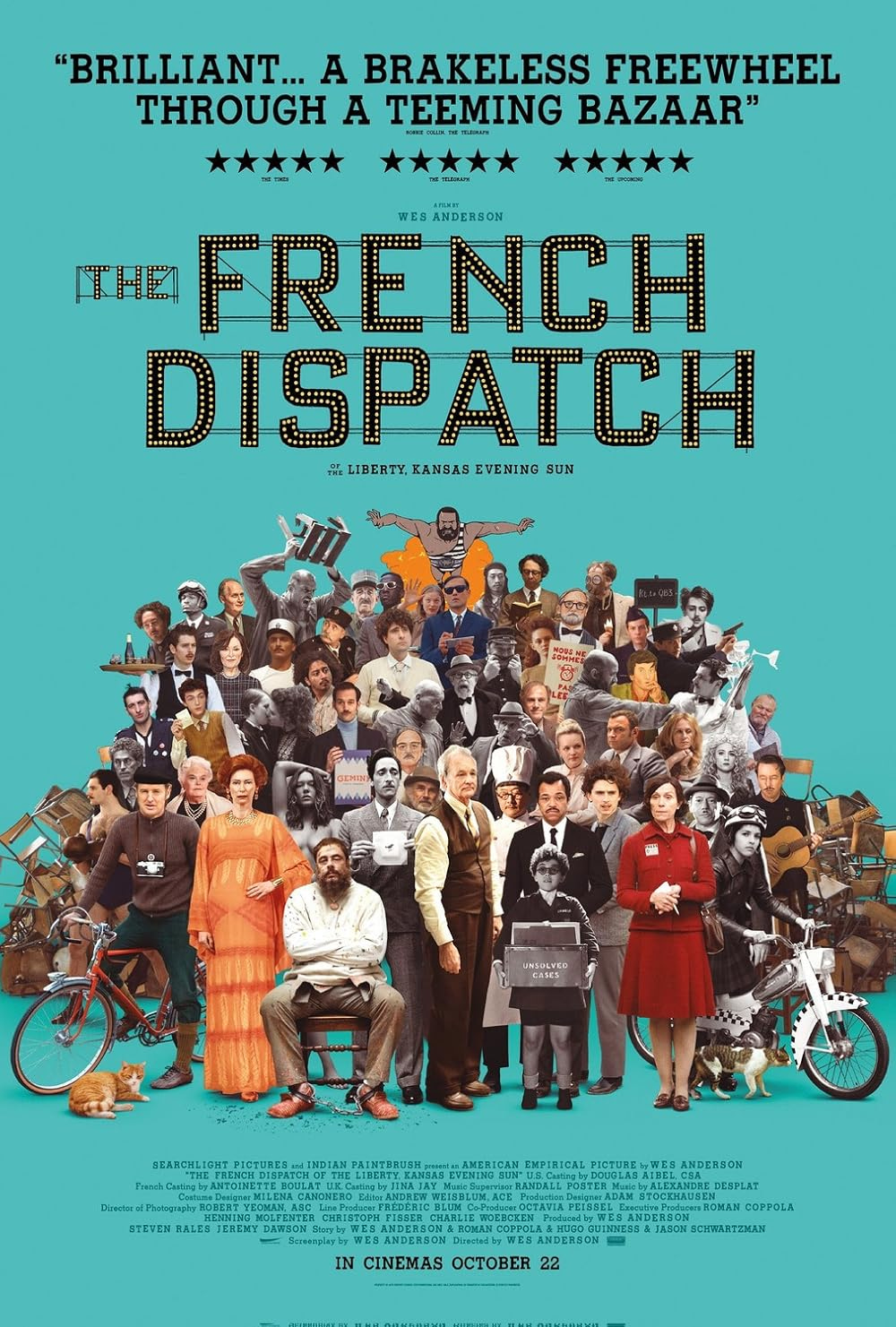
It’s not that Journalistic Neutrality is a conceit so much that our perception of the phrase “journalistic neutrality” is so. As the conceit it’s so often imagined as, Neutrality would attempt to somehow be for and against the simultaneous self-aggrandizing and self-destruction perpetuated by the West. Actual Neutrality, meanwhile, refuses to witness these obsessions as anything other than what they are, and presumes no superiority in the space it takes up in this social equation.
And indeed, following the passing of Liberty, Kansas Evening Sun editor Arthur Howitzer Jr. (Bill Murray), his obituary immediately makes to dissolve and liquidate the newspaper, itself created in America but based in France; a colonial ouroboros. With his death, he’s adamant that the instrument of his witnessing (by proxy of the writers he hires and hosts) dies with him, because — unlike the West — he’s under no illusion that his material legacy would be able to carry on his real-or-imagined relevancy, and so he might as well give no one the space to even assume it could.
Consider: The rats, gigolos, pickpockets, dead bodies, streetwalkers, prisons, and urinals that Sazerac (Owen Wilson) refuses to substitute with flower shops or art museums, together with his remark of the old maxim “All grand beauties withhold their deepest secrets” as the French flag slowly drifts into the frame.
Indeed, why else loudly insist upon the verdict of your own glory if not to distract from the much bleaker evidence that can be readily gazed upon wherever you plant that flag? Sazerac’s segment is shorter because it need only deliver the thesis statement: the Western union of aggrandization and destruction.
Consider: A love affair between a prison guard (Léa Seydoux) who was illiterate until her twenties and “likes to stand still,” and a remorseless first-degree murderer-turned-artist (Benicio del Toro) who the elites are hungry to hallucinate as a genius, judicial double standards and all.
Put another way, consider this loveless agent of the state acting as the artistic and sexual muse of personified squalor, hunger, loneliness, mental illness, and physical violence. She, who deems these things erotic because her experience of freedom feels enhanced by the captivity she keeps him under. It’s probably no coincidence that the elites’ valuation of his art — in full display of the socioeconomic privilege of tastemaking — occurs when that same art serves as an aggrandizement of the very thing that enslaves the artist. It’s more than just Simone who’s naked here.
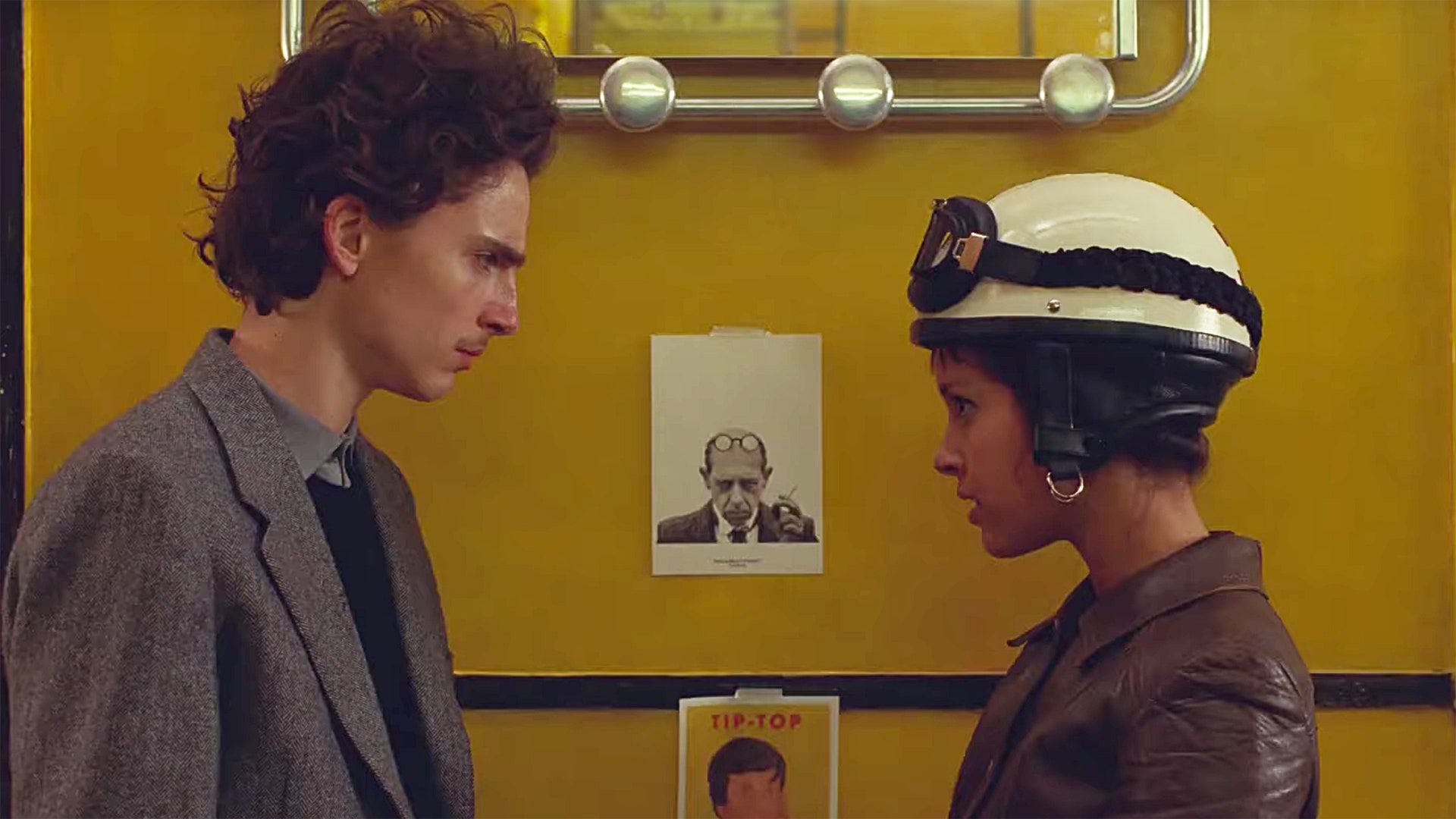
Consider: A student revolutionary group doomed to inevitable infighting through the animus of moral absolutist contrarianism, which itself would mostly just prefer to fuck Zeffirelli (Timothée Chalamet), the face of said revolution. Zeffirelli, who gets worked up over being in trouble with his mother, wonders what’s proper, is poetic for better or worse, and dies in a river while daydreaming of cosmic space-time before being immortalized on many a t-shirt in many an obedient classroom.
All of them, perpetrators of the same self-aggrandizement and self-destruction, and — accordingly — not a single toppled republic to their names. It is the moment that Krementz (Frances McDormand) begins with the typos of Zeffirelli’s manifesto before he demands it not be critized, that we realize this will not be the last manifesto she proofreads, either. You can’t get more neutral than corrected typos. Just go make love, you fucking narcissists.
Consider: The worldly consequentiality of food in its ability to both sustain (via nutrients and companionship) and kill (via poison), overshadowed by yet another factoried veneer of prestige in Nescaffier (Stephen Park), whose life as a foreigner depends on him not being a disappointment to anybody, and seeing as how he’s aggrandizing the sensation of a new taste in the toxic salts that almost killed him, he seems to be fitting in quite nicely. At what cost, you ask? Something that’s missing, just as the colonizer likes it.
It is the promise of food — accepted on account of its prestige — that neutralizes the standoff between the police and the criminal syndicates of Ennui-sur-Blasé, and by extension becomes the catalyst for an improbable, tearful reunion between a son and his police commissioner father (Mathieu Amalric), who was up until that point build-a-babying him into the future police commissioner.
The aggrandizement of the source of poisoned food (i.e. renowned chef Nescaffier) begetting the self-destruction of the syndicate, and the strangest thing of all is a father and son hugging. Indeed, love the wrong way and you’ll find yourself in great jeopardy; a jeopardy that can be neutralized by True Neutrality, who will hire a queer immigrant as quickly as a white Frenchman, so long as they can write and don’t cry.
I hope Wes Anderson puts out a novel one day.
Hamnet

There come two major inflection points in the life of every human; the moment when living in the world becomes a responsibility (the end of childhood), and the moment when you stop living in the world (death). This subsequently divides a human life into three conceivable acts; the other two — so as to round out the Shakespearean five-act structure — are for that human’s loved ones, who still bear the responsibility of living in the world.
Agnes (Jessie Buckley) is the platonic ideal of one who well and truly lives in the world, due to her practical, earthly knowledge in the realm of natural medicine that can leverage the tangibilities of the Earth in direct service of objective, physical human vitality. She, more than anyone, makes to inhabit — really inhabit — this new world without Hamnet, her grief bound to corporeal presence (the house where Hamnet lived and died) and biology (she is his mother).
And yet, her grief is not solely that of a mother’s. It is also of material life helplessly reckoning with the immateriality of death, which — categorically — cannot be lived in; it must be processed with belief and imagination.
Luckily, belief and imagination comprise the bulk of Agnes’ actual characterization (and naturally so, for reasons we’ll get to momentarily): Agnes will go to her in-laws’ church, but will not speak a word inside of it. She will blow wishes into her dead hawk and watch her children find comfort in doing the same. She will aggressively insist upon the forest to be the place of birth for her children. She gains visions via the touch of a palm.
None of these traits are anchored in the practicalities of something like her medicinal prowess; they can’t be, because skills do not characterize people. No, characterization is the purview of beliefs and behaviours and emotions; the things through which humans actually experience the world, and which only exist in the etherealities of imagination.
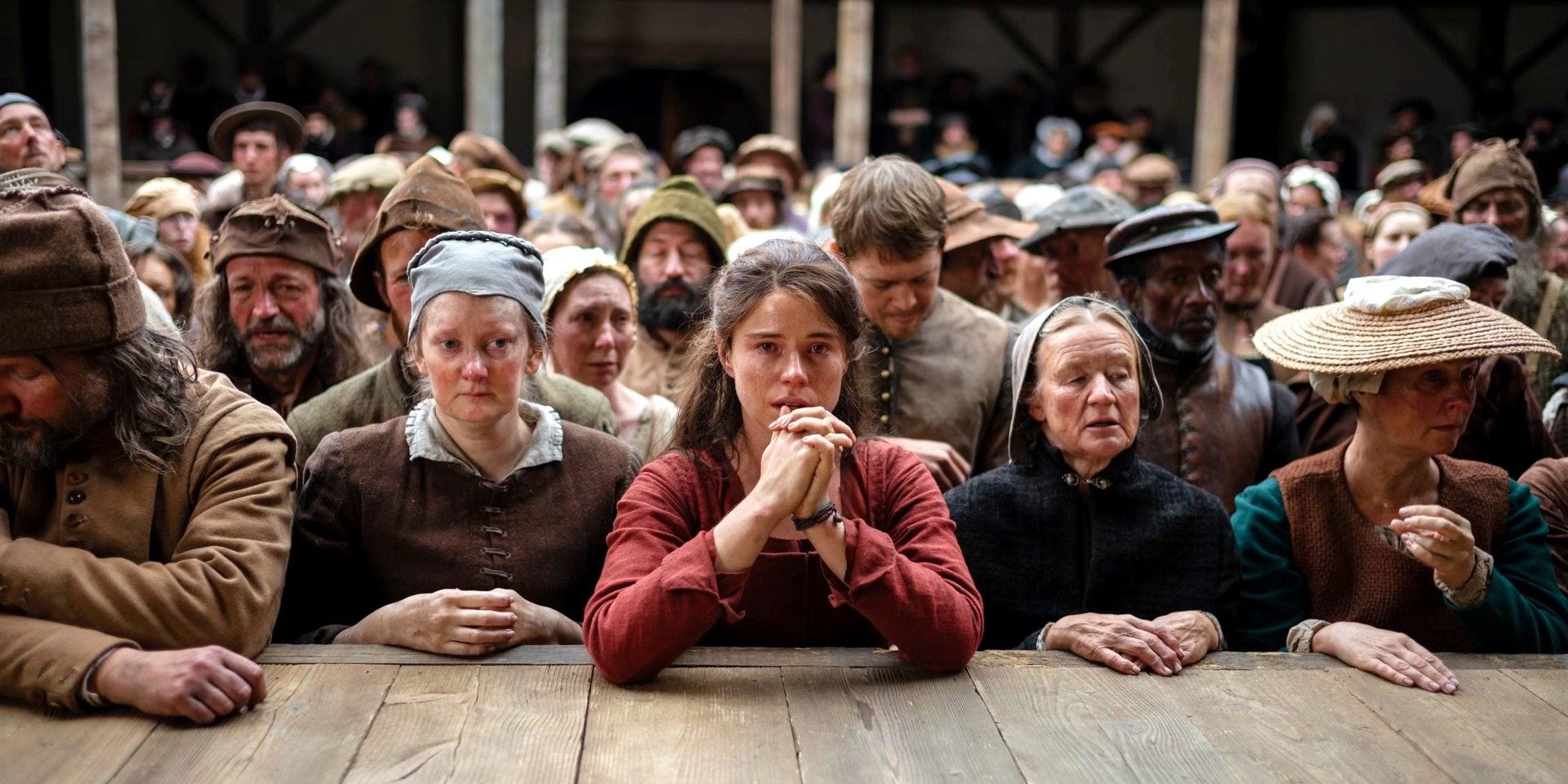
William (Paul Mescal) suffers from his inability to live in the world. His father beats him for not working with his hands, his absence at the time of Hamnet’s death becomes his sinner’s lament, his natural habitat of story visibly torments him to the point of alcoholism, and one of the first things he ever tells Agnes is that he’s not good at talking to people.
But, though agonizing for him, it’s all providential. Not living in the physical is Will’s sin and punishment, and yet it’s his habitation of imagination that leads to its identification — by the narrative, and ostensibly by the characters — as the supreme (and universal) human relativity.
It happens when he finally manages to articulate his grief through the first-ever staging of Hamlet, at which point grief itself becomes unbound from the aforementioned physicalities of presence and biology and is finally allowed to breathe in its own natural habitat of perceptive experience; an experience that can be shared with strangers in the grounds of a theatre, whose tears help to validate the reality of it all.
Tremendous work. Not my cup of tea, but abundant affinity for some of the leaves or something. Respect for launching Jessie Buckley to her long, long, long overdue flowers.
re Twinless, I was left less with a sense of pessimism and more struck by the final admission from Dennis, that Rocky thought of Roman as the good twin. (darkly funny for the waitress to interrupt the genuine and true emotional moment.) both because of the ambiguity in whether or not the descriptor of Roman as "better" is true vs. forever subjective, plus the way it applied to the situation at the table (where Roman was undoubtedly the "good twin" at the table, or the "victor" as you've referenced).
I’m enjoying what you choose to talk about, what you notice about a film, when reviewing one, Charlotte. Learning from you, too, including some new words (“stentorian” from F1 review, and “ouroboros” from French Dispatch). Cracked up at “the mother of all white knuckling” in F1. Will read Twinless review after I finish watching.