
Doctor's Notes: Crime 101, Magellan, Chopping Mall, and Eraserhead
on compilation cinema, slow cinema, cryptids, and the Shakti

Welcome to Doctor’s Notes, where I — Charlotte of The Treatment — share some shorter but still Treatment-coded reviews for films I’ve watched lately. This will largely comprise recent and/or more commercial films so that I can keep my foot in the Rotten Tomatoes door while also introducing the widest possible audience to the New Film Criticism.
If you’re coming here from Rotten Tomatoes, know that “Fresh” and “Rotten” ratings indicate my personal enjoyment of the film only; they are not a testament to whether or not they’re worth watching. If I write about a film, that means I consider it worth watching.
I give star ratings for every film I plan on including here over at my Letterboxd account, where these reviews will then be posted after the Doctor’s Notes post goes live. Follow me to get a sneak peek at what I plan on writing about!
Before we get into this, a quick reminder that my ND50 film, The Bear & Mouse Variety Hour, will be screening in the Filmstack Discord screening room this Saturday, April 25 at 3PM ET
Table of Contents
Crime 101
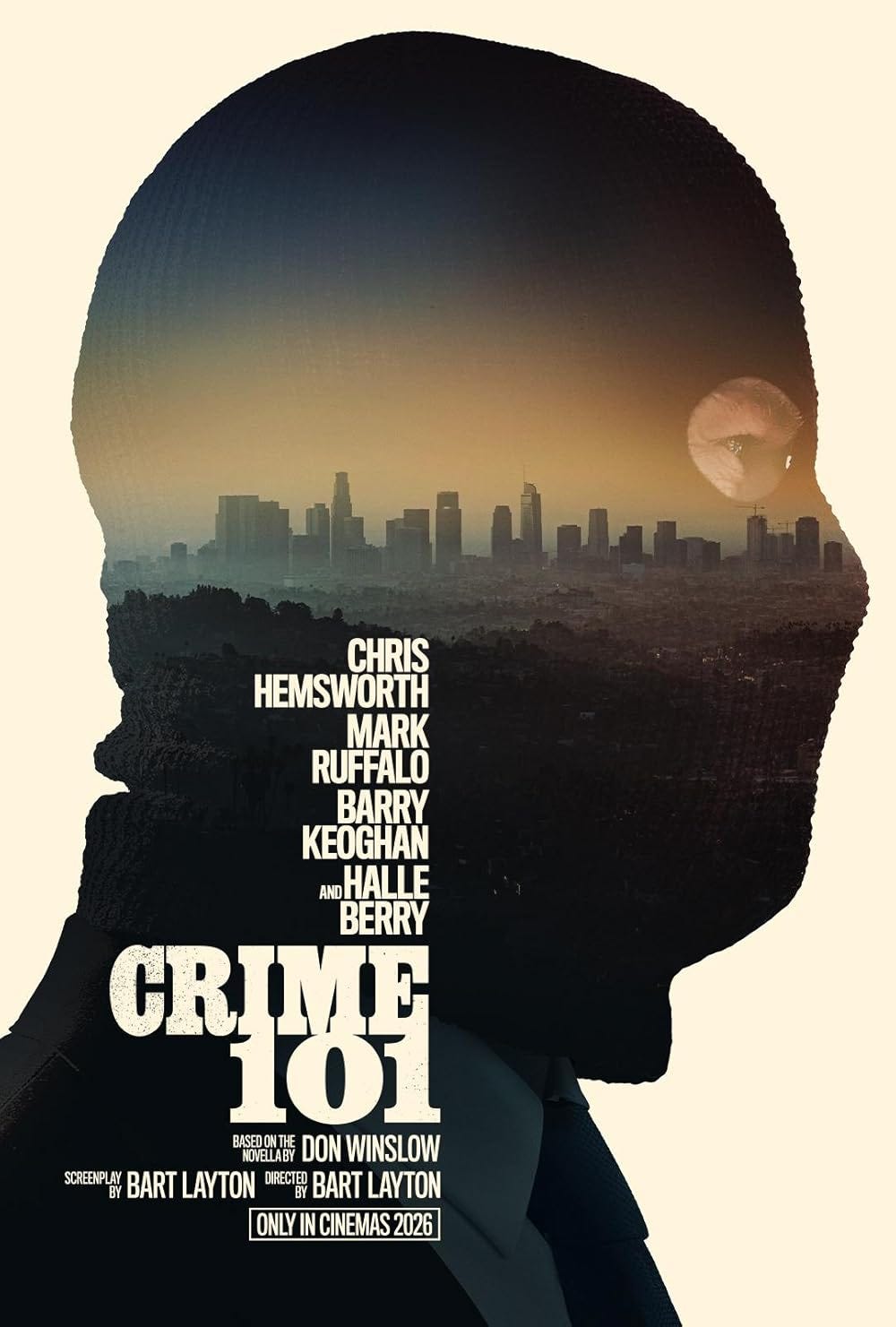
Crime 101
One of my favourite albums — Stratovarius’ Enigma: Intermission II — is a compilation album, and is therefore a release that’s not interested in expanding the boundaries of Stratovarius as a band/artist so much as it’s interested in aggregating fragments of the journey so far into a compact, new-approximate interpretation of the band’s established artistic arena.1
Put another way, where a brand new album would be a full step forward, a compilation album would be a half-step — the aggregation and rearrangement of an essence, but not its expansion. A zebra as opposed to a unicorn.
Similarly, there is nothing about Crime 101 that hasn’t been explored in other, more specialized films that make a concerted effort to break ground in its thematic territory. There’s nothing revelatory about:
Crime being an all-too-common and by-design pipeline for those living in/who have lived in poverty like James Davis (Chris Hemsworth), nor about
The hard work = reward poppycock of the “legitimate” corporate world that Sharon (Halle Berry) occupies until she doesn’t, nor about
The unending thanklessness of trying to be a non-corrupt cop in an enterprise as fundamentally corrupt as law enforcement, nor about
The aesthetics of gross privilege often being underpinned by a reality of criminal activity, nor about
The violent front that masks — and, in the same breath, signals — the desperation and vulnerability of kids like Ormon (Barry Keoghan), nor about
Writer-director Bart Layton’s tendency to attach the camera to vehicles, because we humans might as well be the beheld party in the context of American materialism and class warfare.
But to that very same point, there come to mind (mine, anyhow) very few films that activate the crime genre’s thematic ballpark with the breadth that Crime 101 does here, because — with none-too-little subtly per that title — this is a broad crash course on said territory; compilation cinema, if you will.
I generally believe that the most respectable thing one can do as a professional artist is challenge the boundaries of or introduce new lenses to your chosen territory or subject matters2, but there’s also something to be said about what compilation cinema brings to the table. You can watch Crime 101 and walk away with a very basic but broad awareness of the capitalist fabric that you can then funnel into films like, say, Chinatown or Rebel Ridge. Bonus points for when such films acknowledge its intentions and debts with so much candor.
Debt… Now there’s another way to think about this; maybe Crime 101 paid its genre debts under duress/at gunpoint, and was left with no real estate or autonomy to actualize its own perspective on the subject matter. How’s that for the banal ouroboros of the American project? Maybe there’s no thematic ground left to cover because the flag stole it all. In many ways, after all, Ormon never got to be himself.
Yeah, yeah, Hemsworth’s accent is dire. So is Barry’s (was he even doing one?). The romantic subplot annoyed me to the extent that it made sense. A fair bit of weightless Hollywood slick that I struggled to stomach here, but I can’t say it really compromised the text.
Chopping Mall

In the years since Chopping Mall — produced by Julie Corman, the widow of cost-cutting wizard Roger Corman, and whose subsequent proximity to the business meant her work existed firmly at the intersection of entertainment and commerce, as so much cinema does — was released, some critics have interpreted the film as anti-capitalist commentary on account of A.) Its mall setting, and B.) The parable between the robots and the guardians of capitalist interests (cops et al).
But let’s take a closer look here. Consider first what happens in opening scene of the film:
Classic slasher movie opener involving some folks getting mauled by one of the robots…
…only to pull back and reveal this movie as a corporate demonstration video (which the presenter makes sure to describe as “the film portion of our presentation”) for how the robots work.
It is then explained that these robots will be deployed to the upper three levels of the mall (i.e. the important, expensive stores)…
…while one of the investors cautiously remarks on the middle robot’s “unpleasant ethnic quality” (the icon indicating the robot’s number foregrounds black paint to the other robots’ white and red paint).
I could go on, but you get the idea; overt police state/class warfare political commentary stuffed into every orifice of this opening scene that just so happens to takes place in the room with all the rich people.
Once we move on from this scene, though, it’s pure genre aesthetic. Gore and explosions and sex and death and robots and bullets and stuff; commerce that — to my eyes, anyhow — pretty much exists to sell the movie’s promise. That muchness in our faces can arguably be read as a half-comment on consumerism, yes, but there’s little to distinguish said muchness from that of any given Schwarzenegger or Stallone that unironically encourages said consumption.
This, however, with the exception of one, small, segmented detail:
Ferdy reassures Allison that he knows how to shoot a gun because he “watched Dirty Harry 24 times,” but only succeeds in blinding the robot with a point blank shot before falling unconscious.
Allison, we later find out, knows how to shoot a gun because her father was in the military (i.e. she has actually shot guns before), and she emerges as the final girl; the means through which the narrative win-state is assured by a well-placed bullet from range.
—
Now, look, you can obviously hold anti-capitalist beliefs and infuse those into a Hollywood film, but we’re not being honest with ourselves if we’re saying that a Hollywood film can itself be anti-capitalist, and Chopping Mall seems to understand that.
To recap, the film spends its opening ten minutes fixated on a room full of rich people who — immediately after watching a movie(!) that showed the robots’ lethal apprehension methods — casually voice their concerns about a robot’s ethnic quality while being reassured that they’re there to protect and enable the rich stores. It is overtly political because a room like that is where our political reality actually unfolds; all the movies do is charge you for a dream that, for most, is a satisfying-enough replacement for actual political change. This is by design.
To make matters even less subtle, Chopping Mall closes with salvation coming in the form of the character who actually shoots weapons — and, by the way, blows up portions of the mall while doing so — rather than the guy who just watches guns get shot in movies.
All this, and somehow, someway, the film’s text doesn’t seem to have been interpreted beyond a vague Reaganism consciousness, itself attributed to no sturdier a ground than its shopping mall setting, replete with set-piece after set-piece of all-American stimulation that wouldn’t be out of place in a production bankrolled by the military. Like, be for real, man; would an anti-capitalist film chop off twenty minutes of its lifespan at the whim of a test market? Can you even really call yourself independent if you’re both conceived and boosted through the privileges of Clan Corman?
In any case, I think the sooner we actually and lucidly accept the anti-capitalist film as a gaudy cryptid, the closer we come to making plays toward true anti-capitalism. Retail/fast food workers organizing across establishments and striking by giving away product for free, anyone? Hell, that’s probably what was in the twenty minutes of Chopping Mall that got cut.
Eraserhead
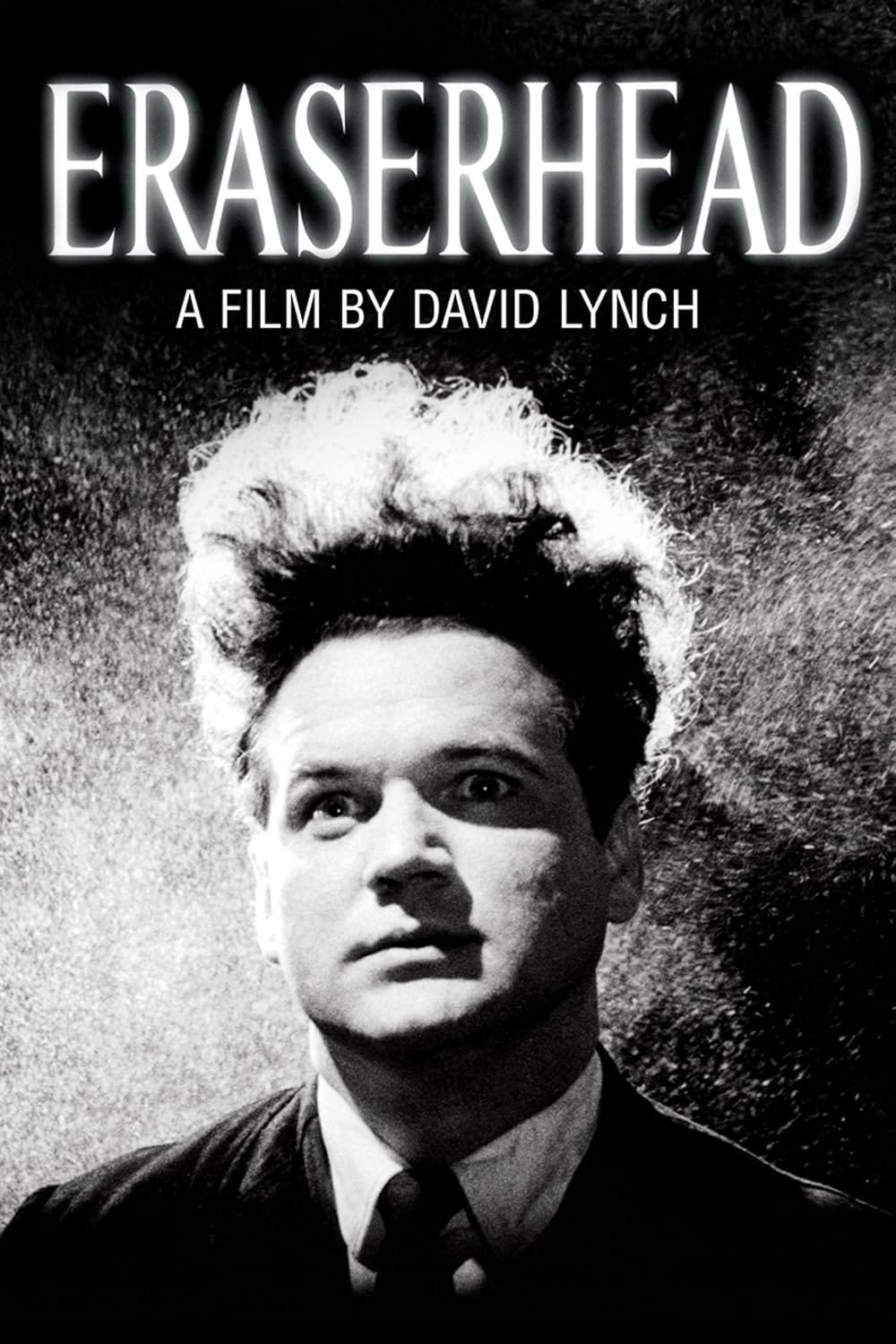
I did not recall until after I watched Eraserhead that this was the film David Lynch once referred to as his most spiritual, and then famously refused to elaborate.
Far be it from me, of course, to elaborate on anything on behalf of David Lynch3, but — even before I recalled said interview — I also don’t remember the last time I watched a movie as spiritually textured as this one, so I think I’m well within my rights to do something of the sort.
We’ll start with Eraserhead’s undercurrent of parental anxiety, which most know about already; Lynch, of course, had been raising a family in a very dangerous part of Philadelphia around the time that Eraserhead was coming together.
Notice the specifics of the undercurrent: How it traffics less in the question of “Am I going to be a good parent” and more in that of “Am I committing a heinous transgression by bringing a child into such a bleak, suffering-abundant world,” per the surrounding industrial hellscape that Henry’s father-in-law remarks on as such, together with Henry’s child contracting a painful illness and having its internal organs held together by nothing other than the hospital bandages, creating a visual language that frames exposure as casualty.
Put another way, Henry embodies anxiety that stems directly from his potential to create life; divine creation, if you will.
Moreover — and this too is something that Eraserhead translators before me are familiar with — Henry also has a pronounced-in-truth if coy-in-expression sexual appetite; an earthly form of destruction whether you understand Henry as one of the consumers/destructors of flesh and human essence, or sex as something that Henry gives himself over to and is therefore willing to have his human essence consumed in pursuit of.
Either way, sex is destruction, which, of course, is inseparable from creation.
(Notice how he’s anxious about meeting Mary’s parents, and later about admitting to Mary’s mother that he and Mary had sex. Henry is anxious about creating(!) new relativities in his sphere; relativities (in this case, new in-laws) that resulted from sex with Mary; destruction begetting creation.)
—
Now here’s where the spiritual hook really comes into play: In Hinduism4, the Shakti is — simply put — the complementary essence of a god; the divine feminine who possesses a creative (Parvati) and a destructive (Kali) side.
If we understand Henry as our god figure, it’s none-too-difficult to understand Mary as Parvati — per her being the complementary creative force in the birth of his mutant child — while Kali can be attributed to the Lady in the Radiator; the dancing woman in his dreams who stomps on and kills (destroys) the sperm-like creatures that we first saw exiting Henry’s mouth at the outset of the film. Radiator Lady later marks the end of the film by embracing Henry; the warmth of his comfort zone that is destruction, safe from the very scary creative.
Scary, that is, unless Henry is dreaming, and therefore insulated from the corporeal consequentialities of the real world that his children may face when he brings them into it. In his dreams, he can spawn endlessly, taking solace in the Planet Man’s existentially negligible disposing of his offspring.
In a sentence, it is the sexful Henry’s anxiety-based wish to inhabit the destructive without the creative, hence “Eraserhead.”
And that’s all the language I think I’m going to give to that.
Magellan

This is neither here nor there and I’m probably in the majority among those with a fondness for slow cinema, but my own pretty much boils down to all the space it gives you to think; always a refreshing counterweight to the monocultural expectation of being constantly entertained.5
Anyway, it’s an incredibly synergistic technique for a story like Magellan in particular, with the camera’s stationary, observational mission complimenting the audacious transparency with which these characters comprehend their political goals.
Consider:
The Portuguese troops listening to a commanding officer’s speech regarding the campaign that lies ahead, with the officer remarking that once Islam ceases to exist, “Christianity will be eternal, and the end of the world imminent,” at once reflecting the colonial imagination’s inseparability from existing for the sake of ceasing to exist, hence its head-first efforts at culture-purging.
An Austronesian woman openly fearing for the day that their native gods will “show us their wrath, their curse,” and the Portuguese higher-up6 demanding that she “not interfere in men’s affairs,” as if fear — the engine of the colonizer’s appetite — is said affair of men, who comprise the majority of said appetite’s bacteria, if you will.
The Austronesian tribe defining their relationship to their gods with tribal song and ceremonial worship and human (if not animal) nurturing, while the Portuguese do so by liberally murdering each other on an oft-dispassionate premise of sin or vague spiritual discord.
The Portuguese openly, lucidly, and even cheerily acknowledging how their mission is to make their king richer and more glorious, the subordinate husks they are.
Magellan dismissing the Lapu-Lapu as a myth, only accepting its existence when he second-handedly finds out about the Lapu-Lapu’s defiance of Jesus, leading him to “confronting” it. This, because the colonial imagination can only perceive of cultures outside of whiteness in the context of hostility.
We find out later — after the Portuguese are massacred in the battle they start — that Enrique fabricated the blood-drinking, fetus-chomping Lapu-Lapu, and that the colonizer’s aggression towards this enemy that didn’t exist led to their unwittingly-desired demise.
Come to think of it, didn’t post-9/11 America convince its citizens that Muslims wanted to take away their freedo- Oops, we’re on the brink of nuclear war.
There’s little in the way of cinematic moralization on the part of the film here. No need for it, really; we’re simply watching the colonizers acknowledge the truth of their mission — a practice that Peter Thiel and the boys seems to be repopularizing after decades of moral panic pretense to help streamline class unconsciousness while slave labour continued under the guise of drug laws — and watching it play towards one of its natural conclusions. In the end, they didn’t even realize they were the Lapu-Lapu all along.
Three original songs notwithstanding.
Insofar as you choose it rather than it choosing you.
Fun fact: He’s one of the five people, dead or alive, I would invite to a dinner, alongside Marsha P. Johnson, Freddie Mercury, Armistead Maupin, and my great-grandmother.
That is, as far as my limited exposure to it can speak to.
Which, fine, but entertainment is one of the primary bastions of control as exercised by the ruling classes, so any full-on moralization in favour of entertainment is indefensible in my book.
This might have been Magellan himself, I don’t know. I’m struggling to recall specific names and faces.
Indeed, salient points, all. Magellan, for all its slow cinema bonafides (and boy, is it sadistic) really lays bare the insecurities and facilities of colonizers in a way that suggests the film is capturing an immediate, current moment in time.
Chopping Mall is a favorite, yes. But it's also part of a certain strand of capitalist yuppie horror films that, I retrospect, probably made the case for conservative greed pretty succinctly. It's interesting to get old and realize, too late, that what I loved was also beloved by others for completely different reasons.
I really don’t know where this ‘missing twenty minutes’ from “Chopping Mall” came from. I worked in post at Corman’s when they shot it (under its original title “Killbots”) and that was basically filmed 2:1 (two takes for each circled). Trust me, I cut the TV version and “Chopping Mall” was barely feature length. I had to add something like eleven minutes just to get it up to 92 minutes so it’d sell in Japan… and eight minutes of that was just the characters watching more of “Attack of the Crab Monsters” on the TV! There’s no #releasethewynorskicut, sorry.