
'The War Between' + My Collaboration with Film Soup
On the blood-soaked loop of the Bilagaana's trail

So, Film Soup.
You may recall that last week’s review took the form of a cross-post from a publication called Film Soup Zine, a brand-new collaborative effort between myself and Kelli over at KLA Media Group.
Simply put, this zine will be dedicated to reviews of and interviews with the makers of tru-indie/NonDē films, and per my recent decision to shift The Treatment’s mainline efforts over to such work, the timing was such that Kelli recruited me and my trusty New Film Criticism to help spearhead this project as launching contributor.
I will, of course, still be publishing the majority of my work on The Treatment; my NonDē reviews will simply have an additional roof over their heads as Kelli and I seek to expand the landscape of NonDē film criticism.
It also wasn’t until meeting with Kelli that I came to realize I could gerrymander a tip button direct to my Stripe account, which is an operational nugget that I’ve since co-opted for The Treatment.
I will never paywall any of my work, but if you feel inclined to throw me a couple bucks to help keep my work going, I would happily reserve a slice of my gratitude just for you.
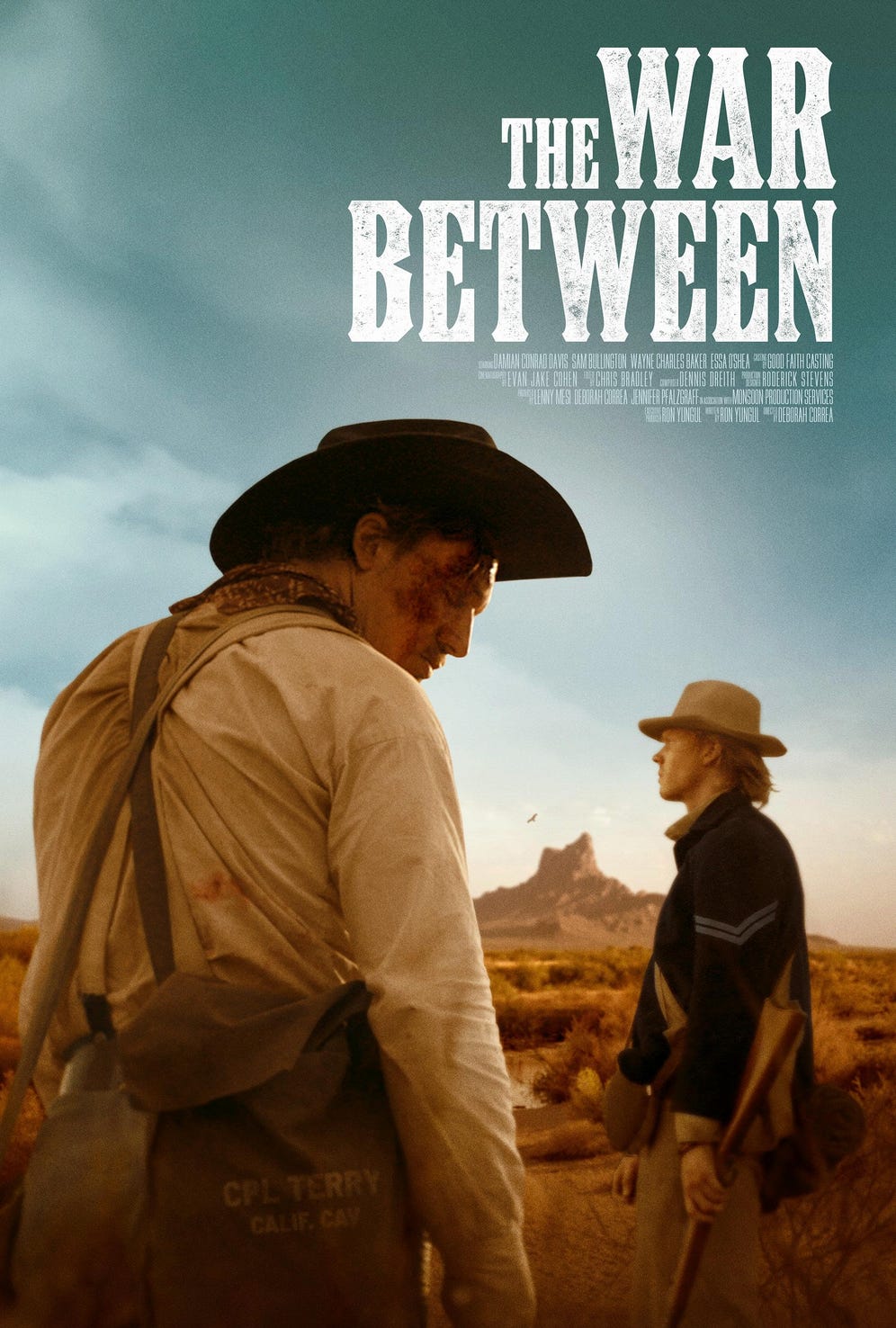
In any case, today’s review is for The War Between, a Western drama masterminded by Deborah Correa (director and producer) and Ron Yungul (writer and executive producer).
The War Between
Set in the year 1862 following a battle at Picacho Peak (where parts of the film were shot on-location), The War Between follows two American Civil War soldiers — one Unionist and one Confederate — who find themselves beholden to the hostilities of the Sonoran Desert. Reluctantly, they agree to cooperate for the sake of survival, where worldly, fateful lessons await them both.
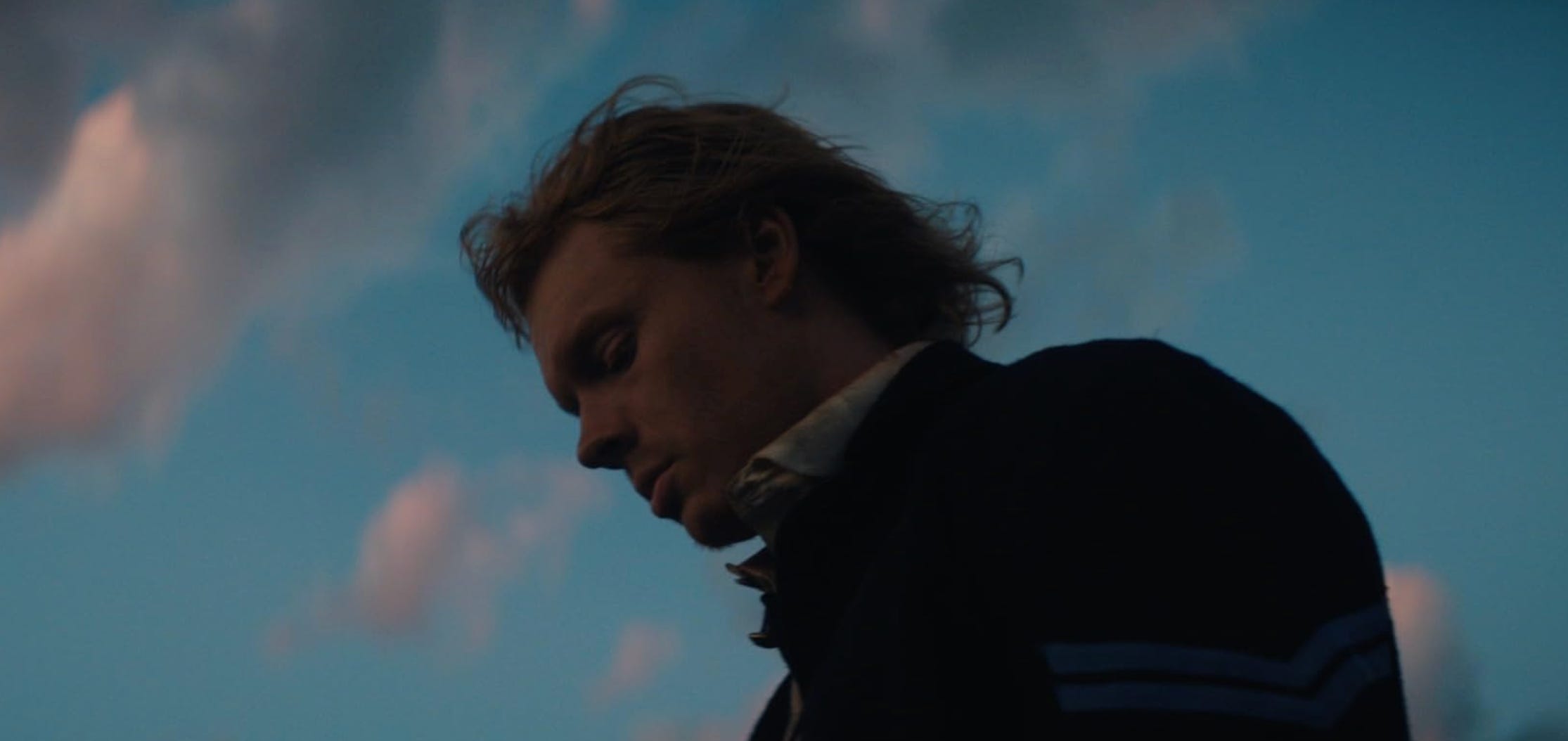
At one point in The War Between, the leader of a group of Navajo people — played by Sage Nicole Hemstreet — serves up what’s ostensibly the story’s thesis to one of the main characters:
“Bilagaana do not know themselves. You’ll kill one another until you do.”
“Bilagaana” is the Navajo word for white people (American colonizers, in this context), and white bodies serve as the site for the eponymous inner war between the outer, guns-and-guts wars we read some version about in history books; to not know oneself, after all, is to be at war with oneself, and there is no clearer sign of not knowing oneself than defining your identity with the hatred/usurping as another.
And indeed, even divided as it was in the early 1860s, the American identity’s common denominator — across Unionists and Confederates — remained exactly this; a fixation on who did not deserve to live here as a human being.
Note: When I say “America” here, I really mean the colonial identity; that of the dilution and elimination of culture, as is the purpose of whiteness as a concept. My own country, Canada, is no better.
Our main characters are Israel Terry (Damian Conrad-Davis) and Moses Jennings1 (Sam Bullington); the former an amnesia-ridden, high-ranking Unionist who hates Indigenous people and was best friends with his father’s slave Atticus (Tank Jones), the latter a lower-ranked Confederate private who’s pro-slavery and was taught to respect Indigenous folk, having gone as far as learning the Apache tongue and customs.
Except, do they — as humans — really hate the people they posture hatred for, or is the American identity just so wrapped up in its legacy of violence and domination that they can’t psychologically reckon with their national identity without entertaining these racist indoctrinations?
Pay attention, for instance, to how both men speak about Indigenous people, slavery, or the war. Their language recalls written propaganda rather than anything spoken from their own minds. Terry’s slapdash polemic about the Great Seer (Wayne Charles Baker) — an Apache wanderer that the duo encounter, fight, and later befriend — is a standout example:
TERRY: He’s a heathen. Unfit to take his place among the rightful heirs to this country.
Moreover, consider how the pair’s exchanges only really become inflammatory when they address things in relation to their perceived strain of Americanism:
Terry finds out that Jennings is wearing his military jacket? He gets aggressive and starts shouting at him about how it’s his jacket.
One takes exception to being given orders by the other? They start pettily shouting about how they’ve promoted themselves in this haphazard army of two, as though the American military ranking order matters here.
Terry finds out that Jennings is a Confederate? He’ll just as soon shoot him dead as accept his help.
For the most part, it’s Terry who aggresses onto Jennings, while Jennings plays a quieter, provocation-manipulation game.
Two sides of the same disease. Terry with his blunt, “progress cannot be stopped” bullishness, Jennings the type to notice when to stop saying “ethnic cleansing” and when to start saying “national security” instead.
But when they’re eating together? Nursing wounds? Doing pretty much anything that’s divorced from the conceptual machine of America and rooted more in the natural fact of human beings and the land we all live on? Both of these men prove to be as capable of compassion for one another as any. Jennings sketches a commemorative picture of Atticus for Terry, and Terry comes to respect and exchange gifts with the Navajo people following his journey with Jennings.
America may be defined by what it destroys, but the humans who it tragically infects? Always and forever defined by what they create and share with one another, should they choose to reject this nationalistic disease.
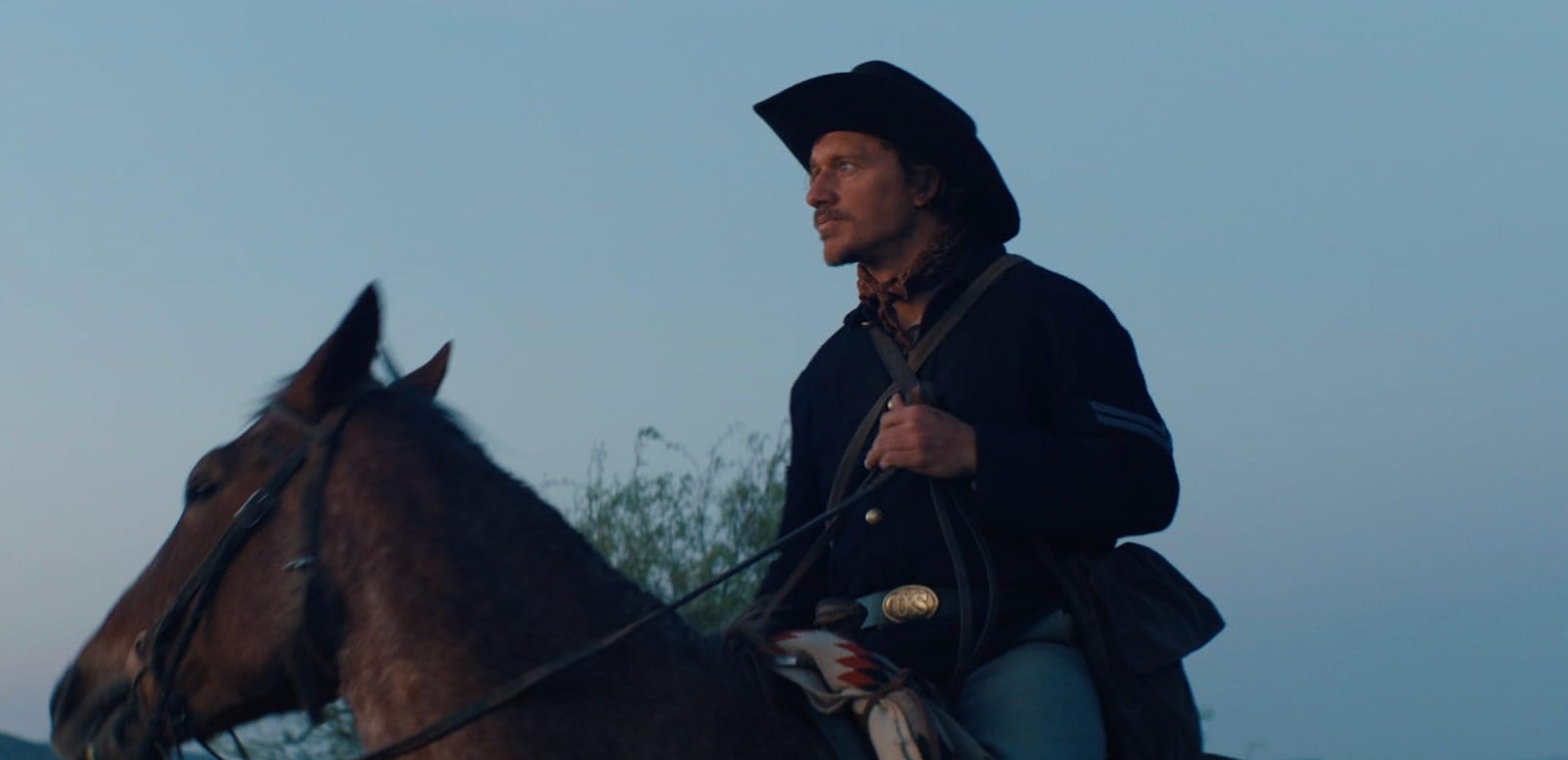
That disease is as follows; the fear-driven impulse to give power to that which burns, destroys, reduces, and dilutes in the name of what inevitably becomes an all-consuming hegemony that convinces you that freedom is a “dangerous idea.” And from Indigenous genocide to the Civil War to Satanic panic to everything we’ve long seen coming from the Trump administration, this disease has always been inseparable from the American project.
One must also, however, recognize the universality of its symptoms.
Consider, for instance, the plight of the Great Seer. We learn that he was cast out from his tribe for — among one other major reason — being struck by lightning and eating a coyote in order not to starve to death, both of which are said to be curses among his people.
But to what end? Where is the practical interest in allowing a natural tragedy to partially deprive a person of their personhood? In marking someone as less-than for eating an animal deemed unacceptable instead of starving to death? Why do we give power to the precedent of humans becoming lesser through no action of their own, and then only enable its rectification through some notion of honour, attained in this context through the act of killing and dominating; a campaign of contagious ghastliness exemplified by the Great Seer’s hunt for other Indigenous scalps in exchange for re-entry into his tribe?
GREAT SEER: What would it cost you to forget (that he’s your enemy)?
TERRY: My honour.
GREAT SEER: You sound like an Apache.
To criticize whiteness is to scrutinize everything that seeks to cull someone of their identity, personhood, and cultural expression, regardless of who brings it to the table.
The Unionists and the Confederates fight each other in the name of imposing their vision of America over the land they fight on. The desert forgives neither of them; with its deadly scorpions, sparse water deposits, and its hosting of the general anarchy that defines forces of pure nature, the land needs no help from the American spectre to carry out its death sentences.
And yet, the spectre — with both the Unionists and Confederates as its worldly weapons — chooses to fight and kill in the name of who is believed to be deserving of the land, as though this bloodthirsty trajectory spares anybody in the end.
TERRY: If it wasn’t trying to kill us, I would almost say it’s beautiful.
You see? The film understands the amoral peddling of death to be the purview of nature, not of humanity, distinct in our ability to create meaning within ourselves, within others, and within our communities. Why, then, would one unimaginatively copy the land and subsequently extend its murderous ways rather than use the human imagination to cooperatively build upon the land in pursuit of shared cultural prosperity?
Well, because Bilagaana do not know themselves enough to lay claim to a culture. That’s why the colonizer kills.
If the purpose of humanity was ruthlessness, then we’re no different from the ground we stand on and the elements that unfeelingly roll over and around us. Is it not far more likely that the human element is defined by the things that only humans can imagine, actualize, and accomplish?
GREAT SEER: Enda… Have no imagination. Lightning! Lightning struck me.
- in response to Terry being confused when the Great Seer refers to a lightning bolt as a “lance of fire.”
It’s that eternal wrestling with its own identity that maintains the invisible wars between the tangible wars that have propped up America’s existence. It’s eternal because America has no identity, and continues to self-define based on accumulation, domination, and suspicion towards the very essence of the other.
The natural escalation of this, of course, is suspicion towards not just the other, but empathy for the other, hence the point-blank murder of people like Alex Pretti, Renée Good, Keith Porter Jr., and others; the true American dream — that of star-spangled oblivion with nothing else to compare oneself to — made manifest.
And without spoiling too much, this is exemplified in what ends up happening to these two men — who pledged themselves to their respective ideas of America — when they come to embrace and accept matters of love and humility, to say nothing of how the Unionists twist the facts in order to enable their continued savagery of the land.
This is not a story of redemption; it’s a story of what happens when one dares to divest from the American project by learning the language of humanity. Bracing stuff; kudos, Deborah and Ron!
The names Israel and Moses obviously weren’t pulled out of a hat. That’s its own essay.
I would love to be a part of Film Soup if you ever need an extra writer!
Ambitious film! Great theme, well explored here.